

Start With a Realistic New Construction Roofing Labor Budget
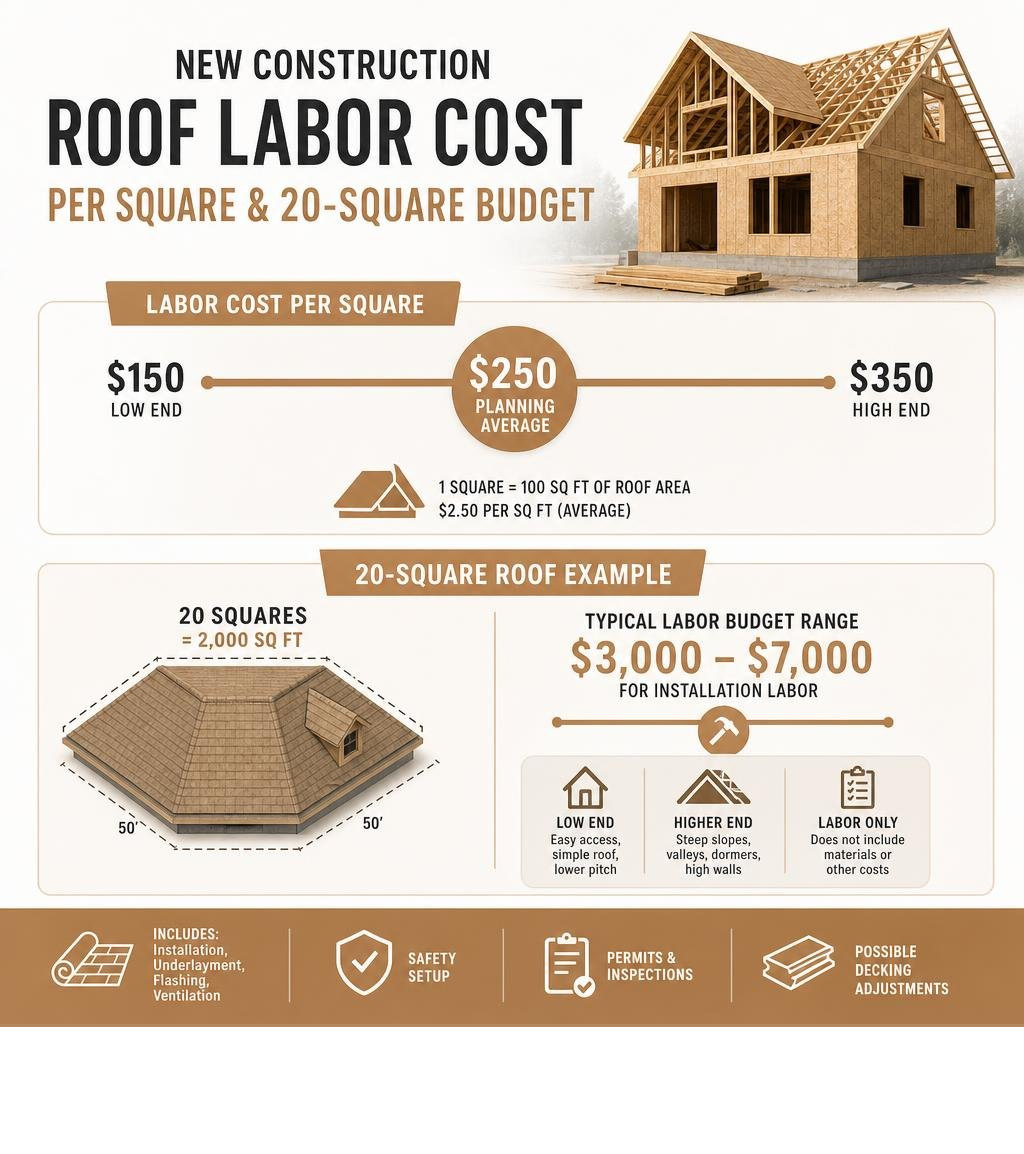
For a standard asphalt-shingle roof on a new build, roofing labor typically costs $150 to $350 per square in 2026. One roofing square equals 100 square feet of finished roof surface. A practical planning average is about $250 per square, or $2.50 per square foot, before materials.
For example, a 20-square roof (2,000 square feet of roof area) usually needs about $3,000 to $7,000 in installation labor. Start with the lower end only if the roof is single-story, easy to access, and has a simple 4/12 to 6/12 pitch. Steep slopes, valleys, dormers, high walls, and local labor rates can raise the number quickly.
New construction avoids tear-off labor, but it still needs a complete budget for underlayment, flashing, ventilation, permits, safety setup, and possible decking adjustments. Getting these items separated in the estimate makes bids far easier to compare before framing is complete.
At Heaton Bros. Roofing, we help Salt Lake City-area property owners understand roofing labor cost per square new construction and make clear decisions about roof installation, repair, and replacement. Our team brings hands-on asphalt shingle roofing experience and a straightforward approach to estimating the work ahead.
Key terms for roofing labor cost per square new construction:
Understanding Roofing Labor Cost Per Square New Construction in 2026

When you look at blueprints for a new build, figuring out trade pricing can sometimes feel like solving an equation where the variables keep changing. In the roofing trade, everything begins with understanding unit measurements. While most residential subcontractors quote in square feet, roofers use “squares.”
One roofing square equals exactly 100 square feet of roof surface area. If your plans show a roof surface measuring 2,500 square feet, that translates directly to 25 roofing squares. For standard residential roofing, labor costs nationwide in 2026 typically range from $1.50 to $3.50 per square foot ($150 to $350 per square). You can also run the figures through an online Roofing Cost Calculator 2026 — $3.50–$14/Sq Ft | CalcSummit to get a high-level view of how materials and labor align.
Converting between units is straightforward:
- Multiply the square foot labor rate by 100 to find the cost per square (e.g., $2.50/sq. ft. × 100 = $250/square).
- Divide the cost per square by 100 to see your rate per square foot (e.g., $300/square ÷ 100 = $3.00/sq. ft.).
That your roof’s surface area is never identical to your home’s interior floor plan. Because of slope angles, overhangs, eaves, and architectural hips or gables, a 2,000-square-foot ground footprint home often features 24 to 30 squares of sloped roof area.
The 60/40 Project Budget Rule
A trusted guideline in construction estimating is the standard 60/40 rule. Across standard exterior installations, labor, equipment rigging, safety setups, and contractor operations make up roughly 60% of the total quote, while physical shingles and dry-in components account for the remaining 40%.
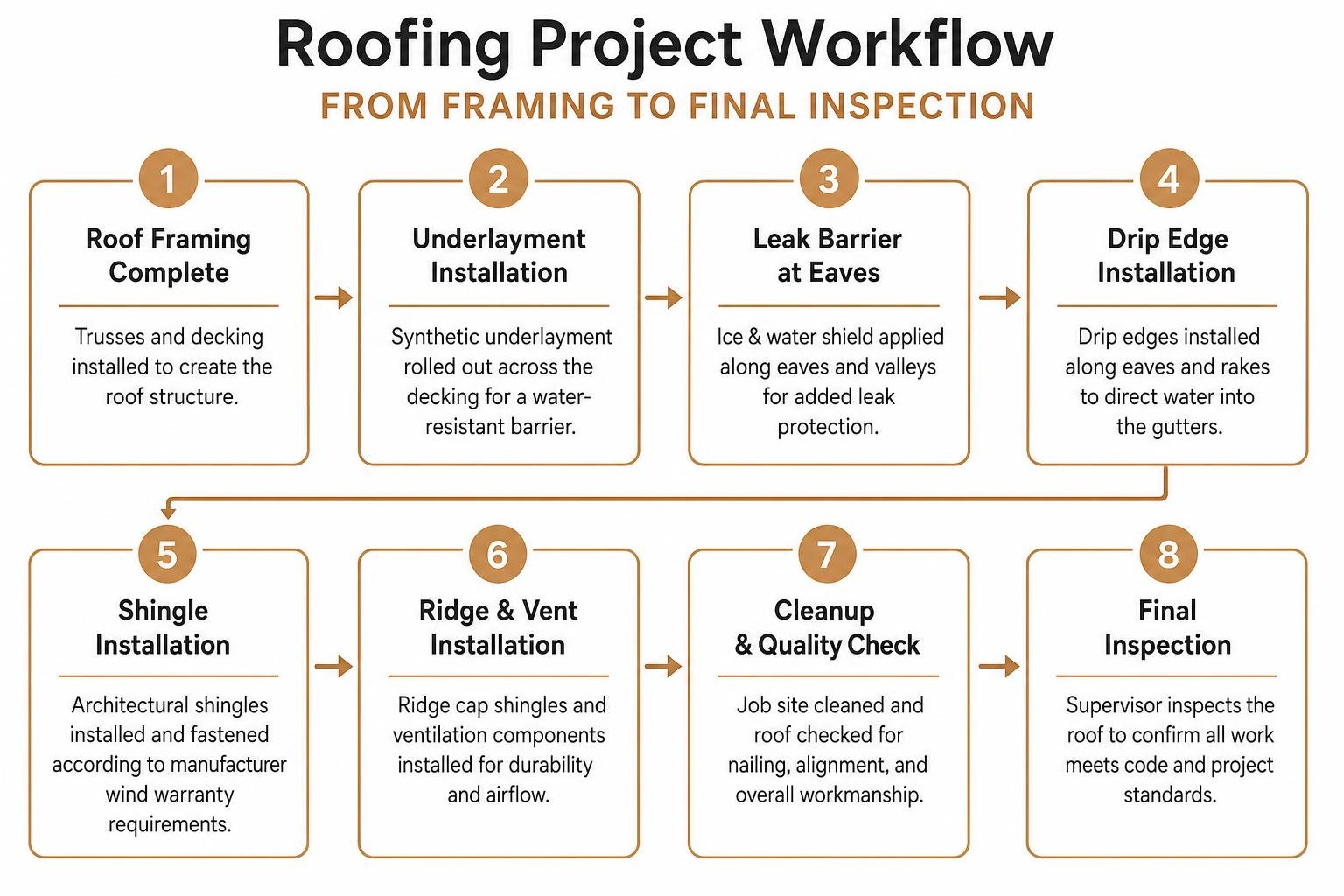
When understanding the roof installation process what to expect, knowing this ratio prevents surprises on itemized bids. While materials like architectural shingles have a predictable per-bundle retail price, labor encompasses extensive on-site execution: staging materials on trusses, applying synthetic underlayment, sealing eaves with leak barriers, installing drip edges, and hand-nailing or gun-fastening thousands of individual shingles according to manufacturer wind warranties.
Crew Sizing, Labor Hours, and Hourly Rates
A typical new construction roofing crew consists of 3 to 5 skilled installers paired with a project supervisor. Depending on the complexity and slope of the home, completing one square of roofing on fresh decking requires roughly 8 to 14 total crew man-hours.
Hourly rates within professional roofing crews break down across skill tiers:
- Journeyman Installers & Crew Leads: $40 to $70+ per hour, specializing in complex valley integration, custom flashing, and ridge cap alignment.
- General Roofers & Shingle Fasteners: $28 to $45 per hour, focusing on continuous field application and nailing consistency.
- Apprentices & Ground Logistics: $20 to $35 per hour, managing material hoists, site cleanup, and loading bundles onto the deck.
On a straightforward 2,000-square-foot roof (20 squares), an experienced 4-person crew operating under good weather conditions can often dry-in, shingle, flash, and complete the installation in 1.0 to 2.0 full work days.
Critical Factors That Influence New Construction Installation Rates
No two sets of architectural plans are completely identical. The time it takes a crew to work across a basic gable roof is far different from navigating a multi-story custom build with multiple dormers, intersecting valleys, and high wall flashings.
| Roof Characteristic | Pitch / Feature | Complexity Factor | Avg. Labor Cost Per Square |
|---|---|---|---|
| Standard Low Slope | 4/12 to 6/12 | Standard Baseline | $150 – $220 |
| Moderate Pitch | 7/12 to 9/12 | +10% to 25% Time Surcharge | $220 – $280 |
| Steep Slope | 10/12 to 12/12 | +35% to 50% Time Surcharge | $280 – $350 |
| Extreme Architectural | > 12/12 / Mansard | Up to +100% Surcharge | $350 – $450+ |
| Complex Valleys & Turrets | Multiple intersections | +15% to 30% Overall Labor | Adds $30 – $60/sq. |
Understanding how blueprints translate to physical installation hours is essential. Reviewing from blueprint to beautiful your guide to new construction roofing highlights how site accessibility, stories, and truss design dictate the final trade bids.
Estimating Roofing Labor Cost Per Square New Construction by Material
Material weight, rigidity, and fastening requirements directly impact how fast a crew can work:
- Asphalt 3-Tab & Architectural Shingles: The standard choice for cost-effective installations. Lightweight and fast to fasten, typical labor runs between $150 and $280 per square.
- Standing Seam Metal Roofing: Requires meticulous layout, hidden clip fastening, on-site panel rolling or mechanical seaming, and custom transitions. Labor for metal runs $350 to $700+ per square.
- Concrete Tile: Heavier components demand slower deck staging and specialized batten layouts, bringing labor to $300 to $500 per square.
- Natural Slate: Exceptional longevity, but each slate must be hand-drilled, sorted, and hammer-nailed, requiring master craftsmen. Labor often reaches $600 to $1,500+ per square.
Consulting the complete guide to roofing materials can help you select a profile that balances long-term performance with your labor budget.
Key Variables Driving Roofing Labor Cost Per Square New Construction
Beyond material choices, specific roof dynamics drive labor bids:
- Pitch & Walkability: Slopes up to 6/12 are comfortably walkable for crews. Once a pitch hits 8/12 or above, workers must set up roof brackets, scaffolding, and continuous fall-arrest harnesses, slowing installation speed by 25% to 50%.
- Valleys and Dormers: Every dormer requires step flashing, counter-flashing, and precise cuts on shingles. These intricate areas can double the labor time needed for those specific sections.
- Deck Preparation: Ensuring sub-framing sheets are flush before installing underlayment is critical. For details on proper substrate requirements, see roof deck installation demystified for homeowners.
Regional Labor Price Variations and Mountain West Dynamics

Labor rates are heavily tied to regional cost-of-living indices, state worker insurance requirements, and local construction demand. According to industry analysis from Roofing Cost Per Square 2026 + Math | The Roofing Brief, regional labor variances across the United States can cause up to a 60% price swing between lower-cost markets in the Southeast and higher-cost metros on the West Coast.
In Utah and the broader Intermountain West, baseline subcontractor labor for new residential builds averages around $200 to $260 per square for standard asphalt applications. In communities throughout the Wasatch Front, such as Salt Lake City, Draper, Sandy, South Jordan, and Lehi, builders must also account for high-elevation weather considerations.
When you schedule roofing services in salt lake city ut or neighboring northern Utah valleys like Ogden, Layton, Provo, and Bountiful, local building codes mandate ice-and-water protection along all eaves extending two feet past interior wall lines to guard against winter ice damming. Installing these specialized self-adhering membranes adds a minor labor premium compared to flat warm-weather states, but it protects the new home from freeze-thaw water intrusion.
New Construction vs. Reroof Labor: The Tear-Off Difference
A major financial advantage of building new is the complete absence of demolition work. On an existing roof replacement, tearing off old shingles, pulling rusted nails, disposing of heavy debris, and sweeping the yard with magnetic rollers costs an extra $1.00 to $3.00 per square foot ($100 to $300 per square).
On a new construction project, your crew steps directly onto clean, newly installed CDX plywood or OSB sheathing. The team can immediately focus on the dry-in phase—laying down ice-and-water shield, synthetic underlayment, starter strips, and drip edges. As detailed in our guide on residential roofing cost explained budgeting for repairs and replacement, eliminating tear-off labor allows builders to allocate more of their exterior budget toward higher-tier architectural shingles or high-performance ventilation.
Permits, Code Compliance, and Decking Allowances
Even without demolition costs, every new construction budget should include allowances for:
- Building Permits: Depending on your municipal jurisdiction (whether in West Jordan, Herriman, or Park City), new construction roofing permits and trade sign-offs generally run between $100 and $500.
- Code-Required Venting: Proper intake and exhaust ventilation (ridge vents, soffit baffles, off-ridge box vents) are required under IRC building codes to maintain shingle warranties and prevent attic condensation.
- Framing Adjustments: If roof truss framing settled unevenly before roofing begins, minor labor allowances may be necessary to correct sheathing dips before shingle application.
Knowing what to expect from a roofing estimate helps builders identify whether ventilation hardware, valley metal, and crane hoisting are included in the contractor’s base bid or billed separately.
How Builders Can Optimize Roofing Labor Costs Without Cutting Corners
Budgeting smart doesn’t mean hiring an uninsured crew working out of an unmarked truck. Quality installation protects your build’s structural integrity, preserves manufacturer warranties, and prevents expensive callbacks.
Here are proven ways builders and homeowners can optimize roofing labor costs:
- Simplify the Roof Line During Architectural Design: If you are still finalizing plans, minimizing unnecessary decorative dormers, dead valleys, and complex pitch changes will significantly reduce installation time and future leak points.
- Schedule During Shoulder Windows: Peak summer construction rushes often stretch subcontractor availability. Scheduling your dry-in and shingle install during spring or autumn windows can secure better crew focus and stable rates.
- Stage Materials Directly on the Deck: Coordinate with your supply house to have shingle pallets crane-loaded directly onto the ridge trusses. This saves your roofing crew hours of manual hauling, lowering overall labor fatigue and job site hours.
- Bundle Exterior Trades: Pairing your roofing contractor with fascia, soffit, and gutter installations eliminates duplicate mobilization fees and streamlines scheduling.
- Ensure Framing is Ready: Make sure roof decking is fully nailed, clean, and free of protruding framing fasteners before the roofing crew arrives so they can begin installation immediately.
Working with an established team is always an investment in longevity; discover why professional roof installation saves you money in the long run rather than chasing suspiciously low bids that cut corners on nailing patterns or safety rigging.
Frequently Asked Questions About New Construction Roofing Costs
How many labor hours are required to roof one square on a new build?
For a straightforward single-story home with a walkable 4/12 to 6/12 pitch, installing synthetic underlayment, edge metals, and architectural asphalt shingles takes approximately 8 to 10 total crew man-hours per square (100 square feet). If the roof has steep angles (8/12 pitch or greater), multiple dormers, or high wall transitions, labor requirements increase to 12 to 16 man-hours per square due to safety equipment setup and intricate material cuts.
How does roof pitch impact new construction labor pricing?
Roof pitch determines whether an installer can walk freely across the deck or must work from safety planks, roof jacks, and harness lines. Pitches up to 6/12 are standard labor. Once a roof reaches a 7/12 to 9/12 slope, labor costs rise by 10% to 25%. Pitches from 10/12 to 12/12 add 35% to 50% in labor surcharges because crew mobility slows down and strict OSHA fall-protection rigging is required.
What is the average total labor cost for a 2,000-square-foot new home?
A 2,000-square-foot ground floor home typically has around 22 to 26 squares of sloped roof area after accounting for overhangs and pitch multipliers. For a standard architectural asphalt shingle installation, labor costs typically total between $3,300 and $6,500 ($150 to $250 per square). If the design features high pitches or custom valley work, total labor can reach $7,000 to $9,000.
Conclusion
Building a new home is an exciting milestone, and getting your roof budgeted accurately before breaking ground keeps your entire construction schedule on track. By understanding how squares are calculated, factoring in pitch and material variables, and partnering with experienced local craftsmen, you can build with confidence.
As a 4th-generation family business with over 65 years of hands-on roofing experience across Salt Lake City, Utah County, and the surrounding Wasatch Front, Heaton Bros. Roofing is here to help you get your project done right. Whether you are building in Sandy, Draper, South Jordan, Lehi, or Ogden, reach out to our team today for your new construction roofing quote and let’s get your new home covered.