

What Does Residential Roofing Cost in 2026?
Residential roofing cost in 2026 commonly falls between $9,000 and $18,000 for a standard asphalt-shingle replacement, but the final price can range from about $5,800 to $46,000 or more. Roof area, slope, tear-off work, damaged decking, material choice, and local labor rates all affect the total.
| Roof type | Typical installed cost | Expected lifespan |
|---|---|---|
| Asphalt shingles | $3.50-$5.50 per sq. ft. | 15-25 years |
| Metal roofing | $7-$12 per sq. ft. | 40-70 years |
| Slate roofing | $10-$25 per sq. ft. | 75-200 years |
A home’s floor size is not the same as its roof size. A 2,000-square-foot home may have 2,200 square feet or more of actual roof surface once pitch, overhangs, and waste are included. Steep roofs, multiple valleys, skylights, chimneys, ice-and-water protection, and hidden wood damage can also move a quote well beyond the starting estimate.
Heaton Bros. Roofing helps Salt Lake City-area homeowners understand residential roofing cost before repairs or replacement begin, drawing on hands-on experience with aging shingles, storm damage, roof repairs, and complete asphalt shingle systems. We focus on clear scopes, dependable timelines, and practical pricing so you can plan the next step with confidence.
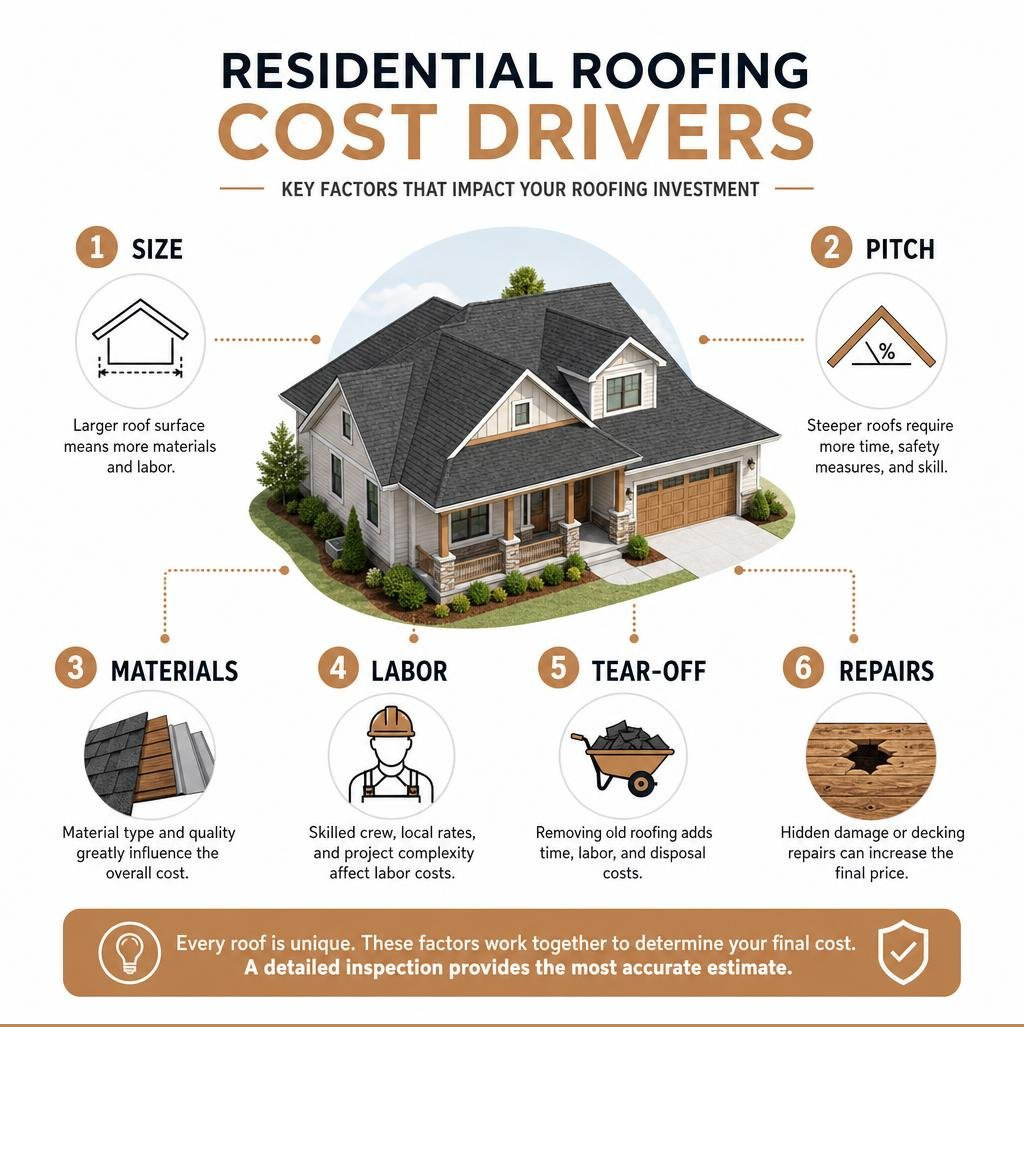
Residential roofing cost terms explained:
Key Factors Driving Residential Roofing Cost in 2026
When calculating your residential roofing cost, looking strictly at standard home square footage will rarely give you an accurate budget. Professional roofing estimates account for several interdependent variables, ranging from raw material trade pricing to labor safety requirements and structural preparation.
Labor typically accounts for approximately 60% of the total cost of a residential roof replacement, while materials, permits, waste disposal, and contractor overhead make up the remaining 40%. Because skilled labor represents the largest share of your invoice, anything that increases the physical difficulty or time required to work on your roof directly drives up the overall project cost.
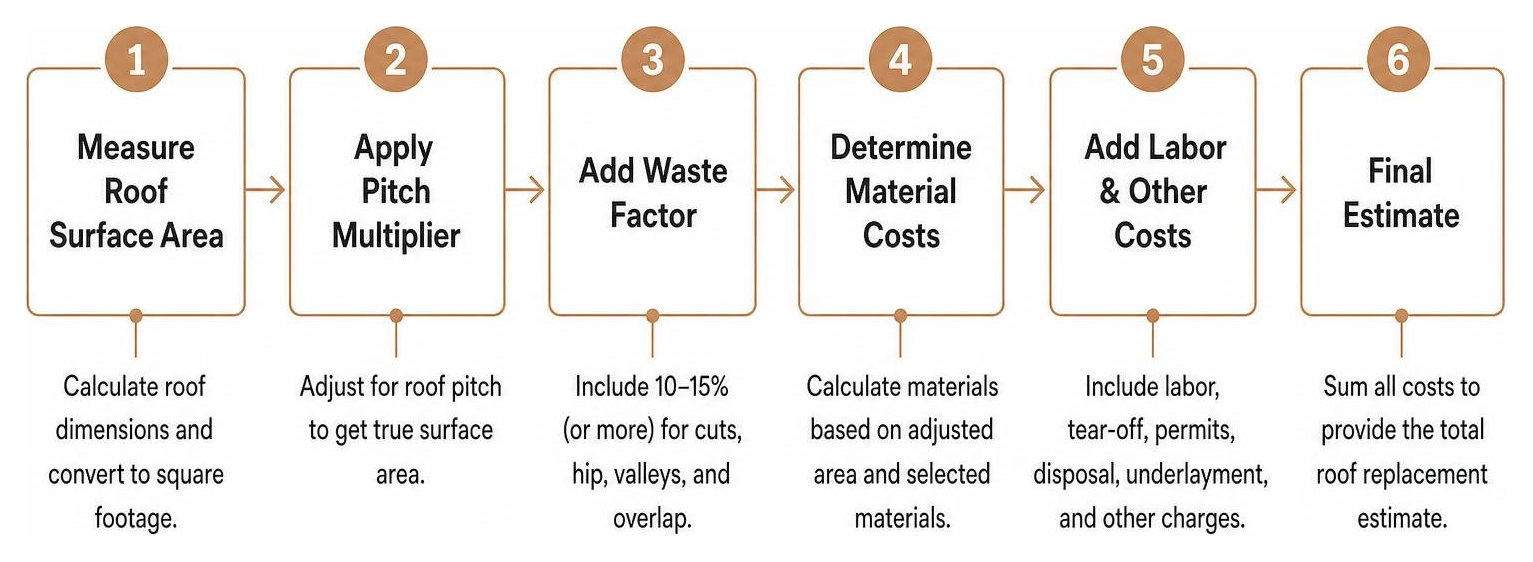
To better understand how these elements stack together during an estimate, consider the step-by-step process used to calculate a complete project quote:
How Roof Size and Pitch Impact Residential Roofing Cost
In the professional roofing industry, surface area is calculated in “squares.” One roofing square equals exactly 100 square feet of roof surface. A 2,000-square-foot single-story home rarely requires just 20 squares of materials. Pitch, slope angle, gables, dormers, and eave overhangs increase the total surface area required.
For example, a home with a modest 6/12 pitch requires a slope multiplier of 1.118, meaning a standard footprint automatically gains roughly 12% in actual surface area. Additionally, a waste factor between 10% and 15% must be added to account for material cutting along hips, valleys, and rakes. If your roof design features multiple hips and gables, that waste allowance can jump to 20%.
Roof pitch also drives labor rates due to safety protocols. Standard walkable roofs (pitches up to 6/12) allow crews to move efficiently with minimal rigging. Once a roof reaches a steep pitch (8/12 to 12/12 or higher), OSHA regulations require safety harnesses, catch nets, and specialized roof jacks. These setups slow down material handling and can add 25% to 45% to labor expenses.
If you are wondering how much does a new roof actually cost?, evaluating your home’s pitch and total square footage is the critical first step.
Labor, Removal, and Hidden Replacement Expenses
Beyond basic installation, several secondary factors can impact your total bill. Unless you are building brand-new construction, your old roof must be removed, hauled away, and disposed of.
- Tear-off and Disposal Fees: Removing a single layer of old asphalt shingles typically adds $0.50 to $2.00 per square foot in tear-off labor and local landfill tipping fees. If your home has a second layer of shingles added by previous owners, expect to pay an additional $500 to $2,500 for the extra labor and heavy disposal weight.
- Decking Repairs: Once old materials are stripped, crew members inspect the plywood or OSB sheathing beneath. If water leaks have rotted the wood decking, these damaged sheets must be replaced before installing new underlayment. Rotted plywood replacement generally costs between $80 and $135 per 4×8 sheet installed.
- Underlayment Upgrades: While basic 15-lb or 30-lb organic felt paper is inexpensive, upgrading to heavy-duty synthetic underlayment provides superior tear resistance and weatherproofing for a small incremental cost ($1.50 to $2.10 per sq. ft.).
- Permit Fees: Local municipal building permits along the Wasatch Front generally range from $150 to $500 depending on project scope and regional jurisdiction.
| Cost Component | Typical Price Range | Notes |
|---|---|---|
| Single-Layer Tear-Off & Disposal | $0.50 – $2.00 / sq. ft. | Includes dump trailer fees and labor |
| Rotted Decking Replacement | $80 – $135 / sheet | Plywood or OSB sheathing (4×8 ft) |
| Synthetic Underlayment | $1.50 – $2.10 / sq. ft. | High-performance water barrier |
| Ice & Water Shield (Eaves/Valleys) | $1.87 – $2.53 / sq. ft. | Critical for freeze-thaw protection |
| Municipal Building Permit | $150 – $500 | Varies by city or county |
Residential Roofing Material Comparison: Pricing, Lifespan, and ROI
Selecting the right roofing material balances immediate upfront costs with long-term performance and home aesthetics. While asphalt shingles account for roughly 75% to 80% of residential installations due to affordability, alternative options like metal, slate, and architectural composite tiles offer distinctive lifespans and styling.
For national price and material benchmark trends, reviewing data like the 2026 Roofing Cost Report: National + Regional Data | TRB demonstrates how material inflation and supply chains influence local trade rates.
Average Residential Roofing Cost by Material
Each material category carries unique trade-offs regarding material weight, specialized labor demands, and durability:
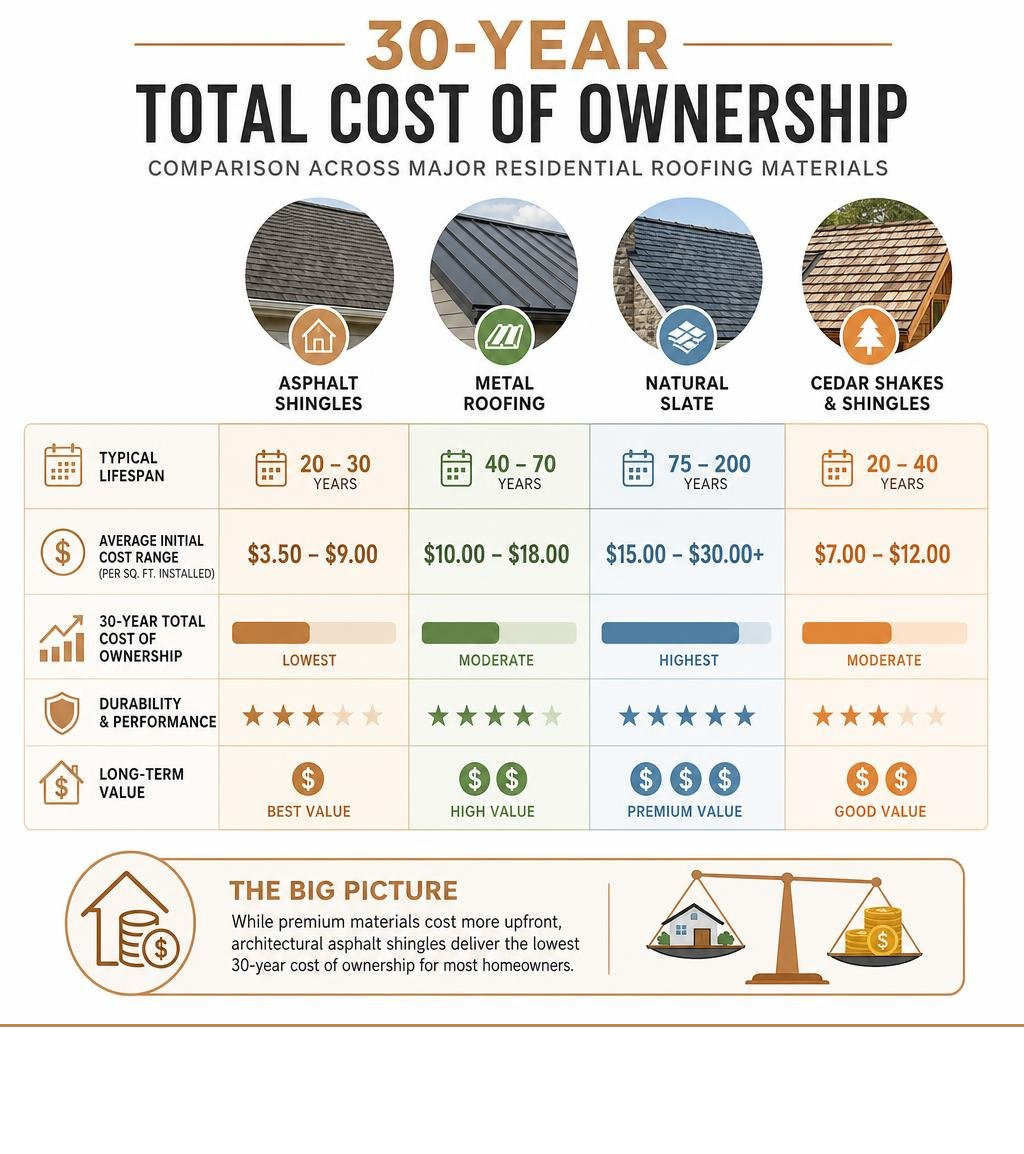
- Architectural Asphalt Shingles: Priced between $3.50 and $5.50 per square foot installed for baseline grades, or $5.00 to $9.00 per square foot for premium architectural laminate shingles. Modern dimensional shingles carry wind resistance ratings up to 130 mph and offer a functional lifespan of 20 to 30 years.
- Standing Seam Metal Roofing: Ranging from $10.00 to $18.00 per square foot installed ($20,000 to $36,000 for a standard 2,000 sq. ft. roof). Standing seam systems feature concealed fasteners that prevent roof leaks caused by thermal expansion, offering a impressive service life of 40 to 70 years.
- Natural Slate Roofing: Represents the top tier of residential roofing, ranging from $15.00 to $30.00+ per square foot installed. Slate offers an extraordinary lifespan of 75 to 200 years, but its heavy structural load frequently requires engineered rafter reinforcement before installation.
- Cedar Shakes and Wood Shingles: Typically range from $7.00 to $12.00 per square foot installed. While naturally insulating, cedar requires routine maintenance and fire-retardant treatments in mountain climate zones.
To explore material choices in detail, refer to our comprehensive guide on the complete guide to roofing materials.
Long-Term Value and Return on Investment
While premium materials require higher initial outlays, their extended lifespans change the long-term financial equation.
According to industry real estate recouperative cost surveys:
- Asphalt Shingle Roofs: Recoup approximately 60% to 68% of their initial installation cost in home equity valuation upon immediate home resale.
- Metal Roofs: Recoup roughly 50% to 56% at resale, while offering long-term savings through reduced utility bills (cool-roof reflective coatings lower summer attic temperatures) and potential homeowners insurance discounts for Class 4 impact resistance.
When calculated over a 30-year home ownership timeline, a quality architectural asphalt roof yields one of the lowest annual costs of ownership ($550 to $700/year), making it the most practical choice for many homeowners. For a deeper breakdown of pricing calculators by size, see the Roof Replacement Cost Calculator 2026 — By Size & Material | CostPrism.
Regional Variations and Seasonal Timing for Roof Projects

Where your home is located and when you decide to start your project significantly affect your final project estimate.
In Utah and throughout the Wasatch Front, harsh winter conditions bring heavy snow accumulation, freeze-thaw cycles, and localized ice damming. Installing heavy-duty ice-and-water protection membranes along all eave lines, valleys, and rakes is not just an optional upgrade—it is a mandatory building code requirement under IRC regulations to prevent meltwater from backing up beneath shingles.
Regional Price Differences Across Municipalities
Labor rates, permitting rules, and regional logistics vary across Utah municipalities:
- Urban & Suburban Metros (Salt Lake City, West Jordan, South Jordan, Sandy, Draper): Higher general cost-of-living and wage demands move labor rates higher, but supply chain proximity keeps freight prices stable. Permitting processes are efficient, though high demand means contractor scheduling fills quickly in peak summer.
- Mountain & Resort Markets (Park City, Heber Valley): Projects in higher elevations encounter stricter snow-load engineering codes, ice dam prevention mandates, and elevated transportation costs for material delivery. Specialized winterization techniques often increase overall labor expenses by 15% to 25%.
- Utah & Davis Counties (Provo, Lehi, Orem, Layton, Ogden): Rapid residential growth creates steady demand. Local permit costs vary by city, with rapid-growth tech corridors enforcing rigorous building inspections.
To learn more about local regulations, examine the Salt Lake City re-roofing lowdown: costs, permits, and pros. Additional nationwide breakdowns can also be explored via the How Much Does a New Roof Cost in 2026? US Pricing Guide.
Finding the Best Time of Year to Replace Your Roof
Roofing contractor schedules follow distinct seasonal curves:
- Peak Season (Late Spring through Summer): Warm, predictable weather creates a massive surge in homeowner demand. Contractor schedules book weeks or months out, and labor rates often carry a 10% to 15% demand premium.
- Optimal Pricing Windows (Late Fall & Early Winter): As temperatures cool before deep winter sets in, overall installation demand slows down. Contractors look to keep their core crews working, making late fall or early winter an ideal time to negotiate competitive project rates.
- Early Spring Window: Spring rain and snowmelt often expose minor leaks created during winter, triggering early service calls. Booking early spring projects before peak summer rush secures better crew availability.
Read our overview on 6 reasons to replace your roof in the spring for tactical advice on scheduling.
Roof Repair vs. Full Replacement: How to Decide
When faced with roof damage, homeowners must determine whether a localized patch job or a complete replacement makes financial sense.
The 25 Percent Rule and Repair Thresholds
A standard rule of thumb in professional roofing is the 25 Percent Rule. If damaged or degraded shingles cover less than 25% of your total roof surface area and the surrounding materials are relatively young, a targeted roof repair is usually the most economical solution. Common spot repairs include:
- Replacing damaged pipe boots or vent flashing ($150 to $350)
- Fixing small isolated storm damage patches ($300 to $800)
- Repairing valley flashing leaks ($400 to $900)
However, if your roof is over 18 to 20 years old, or if structural damage and missing shingles exceed 25% of the total surface, continuous spot repairs quickly become money down the drain. Old shingles lose their protective granules and flexibility, making it difficult for technicians to nail in new patches without cracking adjacent materials.
| Factor | Consider Roof Repair If… | Opt for Full Replacement If… |
|---|---|---|
| Roof Age | Under 12-15 years old | Over 18-20 years old |
| Damage Extent | Isolated to under 25% of surface area | Exceeds 25% of overall surface area |
| Leak History | First-time minor leak from flashing | Multiple recurring leaks across rooms |
| Shingle Condition | Pliable, full granule retention | Curling, brittle, widespread granule loss |
| Deck Integrity | Solid plywood/OSB deck underneath | Spongy, soft, or rotted sheathing boards |
For more guidelines, see our decision guide on roof replacement vs repair: how to decide.
Evaluating Contractor Quotes and Warranties
Comparing contractor bids requires looking past the single bottom-line figure. A bid that comes in 25% cheaper than competitors often indicates missing scope line items, lower-grade materials, or inadequate insurance coverage.
When reviewing estimates, ensure each proposal includes:
- Full Tear-Off Specifications: Explicitly stating disposal of existing shingle layers down to the bare deck.
- Specific Material Brands & Product Lines: Clearly listing manufacturer, shingle style, underlayment type, and starter strip systems.
- Flashing and Drip Edge Replacement: Confirming new metal drip edges, step flashing, and pipe boots rather than reusing worn old hardware.
- Deck Repair Rates: Setting a clear price-per-sheet allowance for any rotted plywood discovered during tear-off.
- Warranty Coverage: Distinguishing between Manufacturer Material Warranties (which cover shingle defects for 25 to 50 years) and Contractor Workmanship Warranties (which cover installation labor errors for 10 to 25 years).
For a complete overview of national pricing ranges across different home designs, reference How Much Does a New Roof Cost in 2026? | The Roofing Brief.
Frequently Asked Questions About Residential Roofing Costs
How much does a new roof cost on average in 2026?
The national average cost to replace a residential roof in 2026 ranges between $9,000 and $18,000 for a typical 2,000-square-foot home using architectural asphalt shingles. Overall project costs can vary from $5,800 for basic homes up to $46,000+ for large homes utilizing standing seam metal, slate, or complex multi-story designs.
What is the cheapest time of year to replace a roof?
Late fall and early winter generally offer the most cost-effective pricing. Contractor demand decreases following the summer peak, leading many companies to offer off-peak scheduling incentives or lower labor rates to maintain steady work for their crew members.
Does homeowners insurance cover roof replacement?
Homeowners insurance typically covers roof replacement if the damage stems from sudden, unpreventable events like severe hail, high wind storms, fallen trees, or fire. Insurance policies do not cover standard wear-and-tear, age-related deterioration, or damage resulting from deferred routine maintenance.
Conclusion
Understanding residential roofing cost comes down to recognizing how size, pitch, material selection, and labor quality work together. While investing in a new roof requires careful financial planning, installing a dependable, weather-tight roofing system protects your home’s structural foundation, increases energy efficiency, and provides long-term peace of mind against harsh weather.
As a 4th-generation, family-owned roofing contractor with over 65 years of continuous service across Salt Lake City and the Wasatch Front, Heaton Bros. Roofing takes pride in offering transparent estimates, superior workmanship, and honest recommendations tailored to your budget.
Ready to find out exactly what your project will cost? Explore our complete range of residential roofing services or contact our team today for a free, no-obligation roof inspection and estimate!