

What Does It Actually Cost to Build a New Roof in 2026?
The cost to build a new roof typically falls between $5,755 and $23,993, depending on your home’s size, the materials you choose, and where you live. Here’s a quick snapshot:
| Roof Type | Typical Cost Range | Average Cost |
|---|---|---|
| Asphalt shingles (1,700 sq ft) | $6,000 – $10,100 | ~$8,000 |
| Metal roofing (1,700 sq ft) | $10,245 – $41,640 | ~$25,000 |
| Tile roofing (1,700 sq ft) | $10,665 – $20,900 | ~$15,000 |
| Slate roofing (1,700 sq ft) | $39,925 – $54,020 | ~$47,000 |
Most homeowners pay somewhere around $9,117 to $15,439 for a full roof replacement on a standard home.
A new roof is one of the biggest home investments you’ll make. It protects everything underneath it — your family, your belongings, your structure. But the price tag can feel overwhelming before you even know where to start.
The good news? 79% of homeowners paid roughly what they expected once they understood the key cost drivers. This guide breaks everything down so you can budget with confidence — no surprises.
Whether your roof took hail damage last season or is simply showing its age, knowing the real numbers upfront puts you in control.
National Averages and the Cost to Build a New Roof in 2026
When we talk about the cost to build a new roof, it is important to realize that “average” is a wide net. Nationally, the median cost sits around $9,117, but in 2026, we are seeing more high-end projects push toward $15,439 or higher, especially when premium materials or complex architectural designs are involved.
For a 2,000-square-foot asphalt shingle roof—the most common size and material in the United States—homeowners can expect a range between $6,885 and $23,993. Why such a massive gap? It comes down to the quality of the shingle, the local labor market, and the specific needs of the structure. In our experience serving the Wasatch Front, we’ve seen that the extreme weather in Utah—from scorching summer sun to heavy winter snow—often necessitates higher-quality underlayment and ice shields, which can slightly nudge these averages upward.
If you are asking yourself, “How much does it cost to replace a roof?” you aren’t just paying for the shingles you see. You are paying for a system. This includes the removal of the old materials, repairs to the wooden deck beneath, and the skilled labor required to ensure the whole thing is watertight. For a deeper dive into the logistics, check out our guide on Planning a Roof Replacement: The Ultimate Guide.
Calculating the cost to build a new roof by square footage
In the roofing world, we don’t usually talk in single square feet; we talk in “squares.” A roofing square is a 10’x10’ area, or 100 square feet. This is the standard unit of measurement for both materials and labor.
On average, the total cost to build a new roof ranges from $4.35 to $11 per square foot. Let’s look at how that scales based on the size of your home:
| Roof Size (Sq Ft) | Asphalt Shingles | Metal Roofing | Premium Slate |
|---|---|---|---|
| 1,000 | $3,500 – $6,000 | $8,500 – $14,500 | $15,000 – $30,000+ |
| 1,700 | $6,000 – $9,000 | $10,245 – $41,640 | $39,925 – $54,020 |
| 2,000 | $6,885 – $12,000 | $17,000 – $29,000 | $30,000 – $60,000+ |
| 3,000 | $10,000 – $18,000 | $25,500 – $43,500 | $45,000 – $90,000+ |
For a typical 1,700-square-foot home, the asphalt shingle replacement usually lands between $6,000 and $10,100. If you move into a larger 2,000-square-foot home, those costs naturally climb, often sitting between $6,000 and $15,000 for standard materials.
Key Factors Influencing Your Total Roofing Investment

Beyond just the size of the footprint, the physical characteristics of your roof play a massive role in the final invoice. If your home looks like a simple shoebox, your costs will be lower. If it looks like a Victorian castle with dozens of peaks, valleys, and dormers, prepare for a higher estimate.
Roof Pitch and Slope Impact
The “pitch” is the angle of your roof. A “walkable” roof (one with a low slope) is safer and faster for our crews to work on. Once a roof reaches a certain steepness (typically a 6:12 pitch or higher), it requires specialized safety equipment, harnesses, and more time to navigate. A steep roof can add anywhere from $1,000 to $3,000 to your labor and material costs because the risk and difficulty increase significantly.
Home Height and Accessibility
Is your home a single-story ranch or a three-story townhome in Park City? Height matters. Multi-story homes require longer ladders, scaffolding, and sometimes even cranes to get materials onto the roof. Furthermore, “accessibility” refers to how close we can get our trucks to the house. If we have to carry bundles of shingles across a massive yard because the driveway is too narrow, the labor hours will climb.
For those living in Salt Lake City or surrounding areas, local building codes and permit requirements also factor in. You can learn more about these local nuances in The Salt Lake City Re-Roofing Lowdown: Costs, Permits, and Pros.
How material selection changes the cost to build a new roof
Material choice is the single biggest variable you can control. Here is a breakdown of how different materials impact the cost to build a new roof:
- Asphalt Shingles: These are the most popular for a reason. They are affordable, versatile, and relatively easy to install. They typically cost between $3.00 and $6.00 per square foot.
- Metal Panels: Gaining popularity in Utah for their ability to shed snow, metal roofs cost between $5.00 and $16.00 per square foot, though high-end standing seam systems can go much higher.
- Clay and Concrete Tiles: These are heavy and durable, often seen in Southwest-style architecture. Expect to pay $10.00 to $21.00 per square foot.
- Slate Stone: The “forever roof.” Slate is incredibly heavy and requires a reinforced roof structure. It is the most expensive option, ranging from $10.00 to $30.00+ per square foot.
For more details on material-specific pricing, you can reference the New Roof Cost Guide (2026). If you aren’t sure if your current roof even needs replacing yet, take a look at our checklist: Are You in Need for a Roof Replacement? Find Out Today!.
Detailed Breakdown of Roofing Materials and Lifespans
When choosing a material, we always tell our clients to look at the “cost per year” rather than just the upfront price. A cheaper roof that lasts 15 years might actually be more expensive in the long run than a premium roof that lasts 50.
Asphalt Shingles (15-30 Years)
Asphalt shingles come in two main flavors: 3-tab and architectural. 3-tab is the budget option, but architectural shingles (also called dimensional shingles) are thicker, look better, and handle wind much more effectively. In the windy stretches of the Wasatch Front, architectural shingles are almost always the better investment.
- Cost: $3.50 – $6.00 per sq ft.
- Best for: Homeowners looking for the best balance of price and performance.
Metal Roofing (50-75 Years)
Metal is incredibly durable. It reflects solar radiant heat, which can help lower cooling costs in the summer—a big plus for those in West Jordan or Provo.
- Cost: $8.50 – $16.00 per sq ft.
- Best for: Those planning to stay in their home for decades.
Slate and Tile (50-100+ Years)
These materials are virtually fireproof and can last a century. However, they are very heavy. If you are switching from asphalt to tile or slate, we often have to bring in a structural engineer to ensure your home can handle the weight.
- Cost: $15.00 – $30.00+ per sq ft.
- Best for: Luxury homes and historic preservation.
To understand which material fits your home’s current state, read Roof Replacement 101: Is Your Home Ready for an Upgrade?.
Premium vs. Standard Roofing Options
Within each category, there are “standard” and “premium” tiers. For example, standard asphalt shingles might have a 110-mph wind rating, while premium versions are rated for 130 mph or higher. In places like Bountiful or Farmington, where canyon winds can be fierce, that extra investment in a premium shingle can save you from a repair bill later.
Standing seam metal roofs are another premium option. Unlike corrugated metal where the fasteners are exposed, standing seam hides the screws under the panels, which significantly reduces the chance of leaks over time. You can explore how to balance these choices in our guide on Affordable Roofing Without Compromising Quality.
Labor, Permits, and Hidden Project Expenses
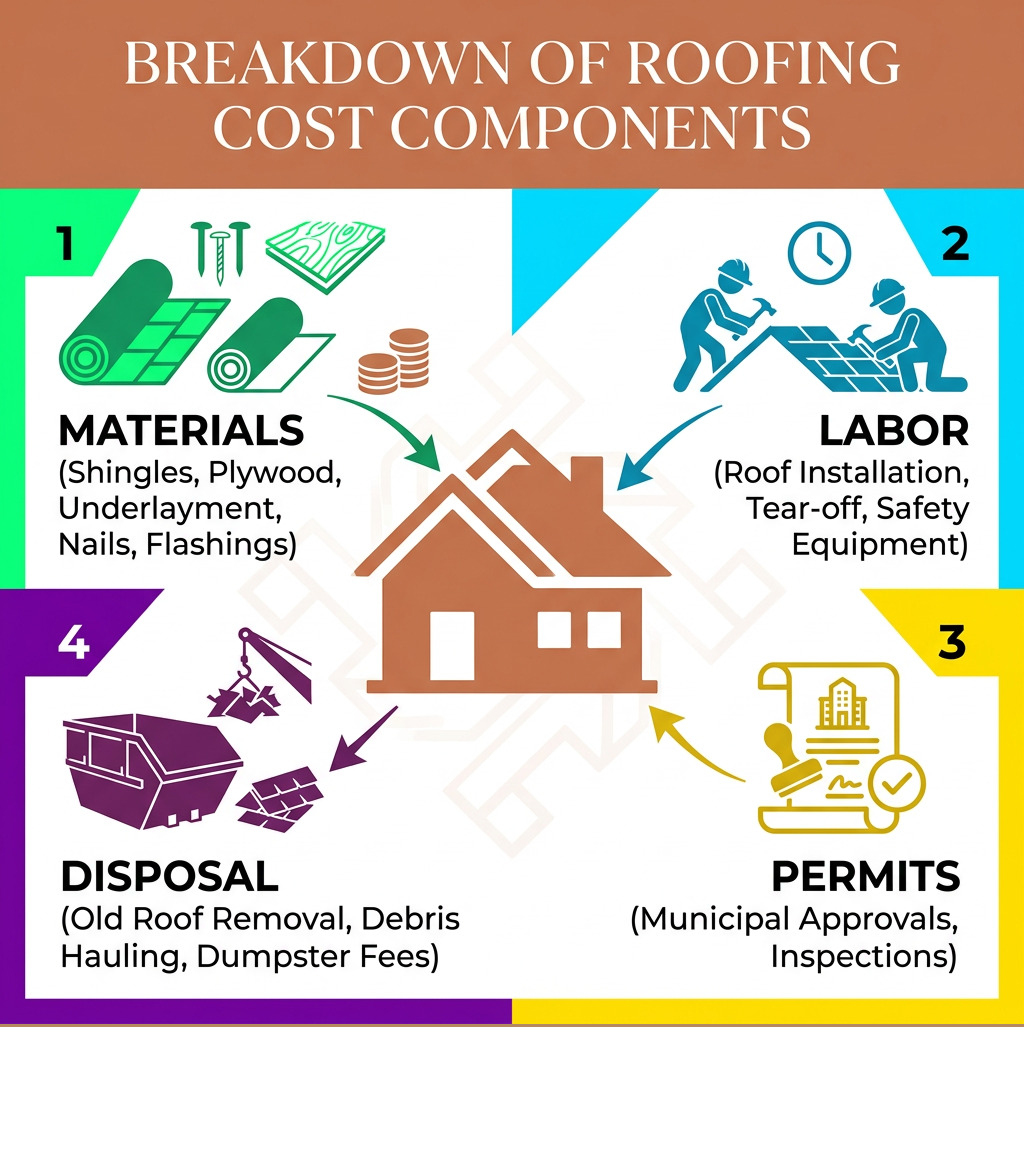
One of the biggest surprises for homeowners is that labor often accounts for 40% to 60% of the total cost to build a new roof. Roofing is dangerous, physically demanding, and requires a high level of expertise to ensure the home remains dry. Typical labor rates for a professional roofing crew hover around $75 per hour, or roughly $1.50 to $3.00 per square foot for basic installation.
Tear-Off and Disposal
Before the new roof goes on, the old one usually has to come off. Roof removal costs typically range from $0.40 to $2.00 per square foot. This includes the labor to rip off the old shingles and the fees to rent a dumpster and haul the debris to a landfill.
Building Permits
Every city from Layton to Nephi has its own rules. Building permits for a roof replacement can cost anywhere from $100 to $1,400 depending on your municipality and the value of the project. We usually handle the permitting process for our clients to ensure everything is up to code. You can find more about budgeting for these “unseen” costs in Don’t Get Soaked: Understanding the Average Cost to Roof Your Home.
Structural Repairs and Underlayment
Once the old shingles are off, we get our first look at the “decking”—the wooden boards that make up your roof’s surface. If we find rot or water damage, those boards must be replaced. Decking replacement usually costs between $2.00 and $3.00 per square foot.
Other essential components that influence the cost to build a new roof include:
- Underlayment: A water-resistant barrier installed directly on the deck ($0.50 – $2.00 per sq ft).
- Flashing: Metal pieces installed around chimneys and in valleys to prevent leaks ($500 – $2,000 per project).
- Drip Edges: These guide water away from your fascia and into your gutters.
- Ventilation: Proper attic venting prevents heat and moisture buildup, which can prematurely age your shingles.
To see how these parts fit together, check out Understanding the Roof Installation Process: What to Expect.
Maximizing Value: ROI and Insurance Coverage
Is a new roof worth it? Absolutely. According to the 2026 Journal of Light Construction Cost vs. Value report, a new asphalt shingle roof offers a 68% return on investment (ROI). Beyond the financial recoup, a new roof provides:
- Curb Appeal: It’s one of the first things people see.
- Energy Efficiency: Modern materials and proper venting can lower your monthly utility bills.
- Peace of Mind: No more worrying about the next big thunderstorm or heavy snowpack.
Insurance and Weather Damage
In Utah, we get our fair share of hail and wind. If your roof was damaged by a “sudden and accidental” event, your homeowners insurance might cover the cost to build a new roof. However, insurance rarely covers damage caused by “wear and tear” or lack of maintenance. If your roof is 25 years old and just leaking because it’s old, that’s likely an out-of-pocket expense.
Deciding whether to file a claim or just pay for a repair? Read Roof Replacement vs. Repair: How to Decide.
Frequently Asked Questions about Roofing Costs
How long does a typical roof replacement take?
For a standard-sized home in the Salt Lake Valley, we can often complete a full “tear-off and replace” in 2 to 5 days. Larger or more complex roofs might take a week. Weather is the biggest wild card—we obviously can’t open up your roof if there is a blizzard or a rainstorm in the forecast!
Is it cheaper to do a roof overlay or a full tear-off?
An overlay (installing new shingles over old ones) is cheaper upfront because you save on labor and disposal fees. However, we generally advise against it. An overlay prevents us from inspecting the decking for rot, it adds significant weight to your home, and it can often void the manufacturer’s warranty. In the long run, a full tear-off is almost always the better value.
Does homeowners insurance cover the cost of a new roof?
As mentioned, insurance covers “perils” like wind, hail, or a fallen tree. It does not cover a roof that has simply reached the end of its life. We always recommend having a professional inspection before calling your insurance company so you have an expert opinion on the type and extent of the damage.
Conclusion
The cost to build a new roof is a significant investment, but it is the most important one you can make for your home’s longevity. Since 1960, we at Heaton Bros. Roofing have been helping families across the Wasatch Front—from Ogden down to Nephi—navigate these choices.
As a 4th-generation, family-owned company with over 65 years of experience, we pride ourselves on providing Salt Lake City homeowners with reliable, affordable, and high-quality roofing solutions. Whether you are looking for a quick repair or a full New Construction roofing system, we are here to ensure you get a roof that lasts for decades to come.
Ready to get an accurate estimate for your home? We’d love to help you protect what matters most. Reach out to us today for a professional consultation.