Is Your Old Roof Hiding a Dangerous Secret?
Asbestos corrugated sheet is a cement-based roofing material that was widely used throughout the 20th century — and it may still be sitting on top of your garage, shed, or outbuilding right now.
Here’s what you need to know at a glance:
- What it is: Sheets made from Portland cement mixed with asbestos fibers, pressed into a wave pattern for strength and water runoff
- Where it’s found: Garages, sheds, warehouses, farms, and older homes — common in buildings constructed before 2000
- When it’s dangerous: When cracked, weathered, or disturbed — intact sheets pose a lower immediate risk, but damage releases microscopic fibers
- What to do: Don’t touch or pressure-wash it yourself; have it inspected and removed by a licensed professional
- Is it banned? Yes, in the UK, Australia, EU, and many other countries — but it remains legal to import in the U.S.
Asbestos was once celebrated for being fireproof, durable, and affordable. What wasn’t known at the time was the serious health threat it posed — mesothelioma, asbestosis, and lung cancer are all linked to inhaling its microscopic fibers. Thousands of people die every year from asbestos-related diseases, many traced back to ordinary building materials like corrugated roofing sheets.
The troubling reality? You can’t identify asbestos by looking at it. Older corrugated roofs often show no obvious signs until they start crumbling — and by then, fibers may already be in the air.
At Heaton Bros. Roofing, we’ve worked with homeowners throughout the Salt Lake City area who discovered asbestos corrugated sheet materials on their properties during repairs or storm damage assessments — and we know how stressful and confusing that can be. Our goal with this guide is to give you clear, honest information so you can protect your home and your family.
The Evolution and Use of the Asbestos Corrugated Sheet
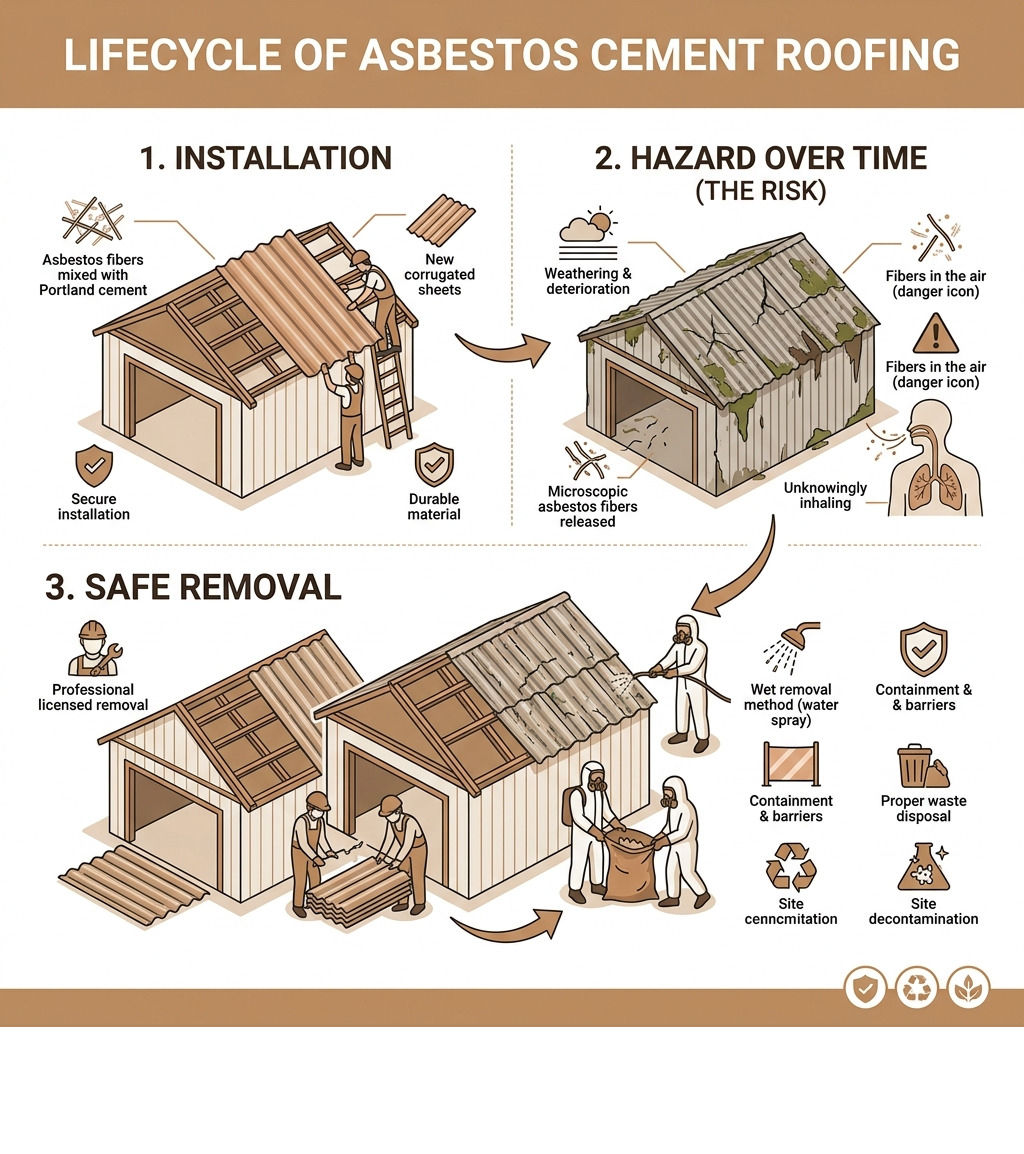
To understand why your garage roof might be a health hazard, we have to look back at the history of construction. For most of the 1900s, asbestos was the “wonder mineral.” It was cheap, practically indestructible, and—most importantly—it wouldn’t burn.
By mixing Portland cement with roughly 15% asbestos fibers (mostly chrysotile, or “white asbestos”), manufacturers created a material that was incredibly strong and weather-resistant. These asbestos corrugated sheet products were the backbone of industrial and residential outbuilding construction for decades.
In fact, asbestos cement products once made up about 90% of all international asbestos production. Between 1946 and 1949 alone, nearly 40,000 post-war temporary houses were built using asbestos cement siding and lining. It was the go-to choice for everything from military bases to backyard sheds.
The Standard Specification for Corrugated Asbestos-Cement Sheets (Withdrawn 2019) shows just how regulated and standardized this material once was. It wasn’t just a cheap fix; it was an engineered industrial solution designed to last 30 to 50 years. Unfortunately, many of those roofs in the Salt Lake Valley and along the Wasatch Front are now reaching the end of that lifespan.
How to Identify an Asbestos Corrugated Sheet by Profile
If you’re staring up at a gray, wavy roof and wondering if it’s asbestos, the “profile” (the shape and size of the waves) can give us a huge hint. While modern fiber-cement sheets look similar, older profiles are very distinct.
- Profile 3: This is the most common type found on residential garages and sheds. The “3” refers to the height of the corrugation. These sheets are generally thinner and have smaller, tighter waves.
- Big 6 (Profile 6): These are heavy-duty sheets often found on larger industrial buildings or barns. The distance from one ridge to the next is about 6 inches (actually 5.7 inches in many historical brands like Super Six).
- Trafford Profile: This is a more angular, “boxier” profile. It was often used in double-clad roofing systems, where an insulation layer was sandwiched between two sheets. These can be trickier to identify because the interlocking design hides the edges.
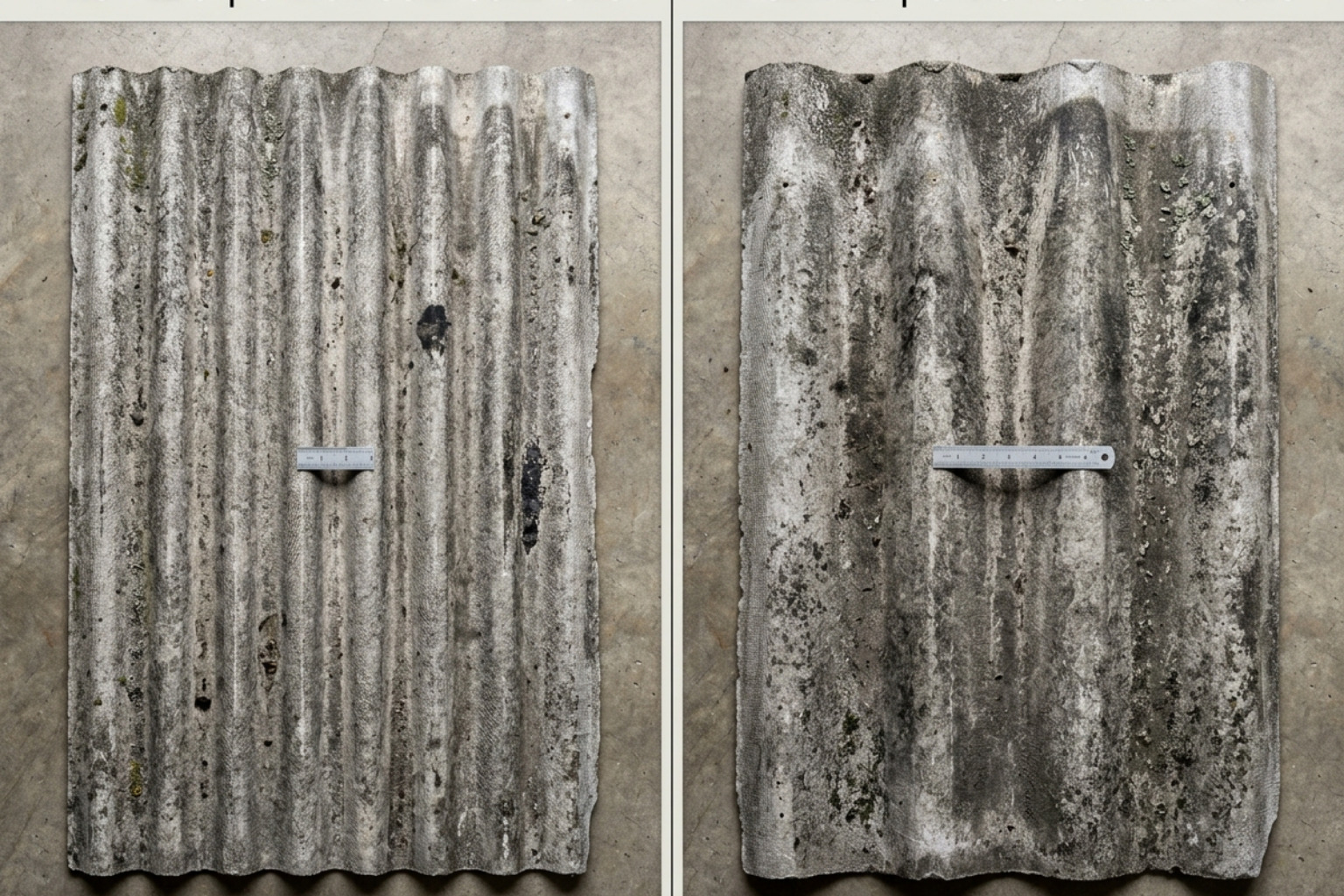
| Feature | Profile 3 | Big 6 (Profile 6) |
|---|---|---|
| Common Use | Residential Garages/Sheds | Industrial/Agricultural |
| Ridge Distance | Approx. 3 inches | Approx. 6 inches |
| Thickness | Usually 4mm to 6mm | Usually 6mm or thicker |
| Weight | Lighter, easier to handle | Heavy, requires structural support |
Manufacturing and Material Grades
The manufacturing process for these sheets was fascinating—and inherently dusty. The Asbestos Corrugated Cement Sheet Explained: Material Grades, Specifications, and Industrial Implementation guide notes that the process involved mixing asbestos fibers with cement and water into a slurry, which was then pressed between grooved metal rollers.
This “wet-press” process ensured the fibers were tightly bound within the cement matrix. This is why the EPA often classifies these sheets as “Category II non-friable” materials. As long as they are in good condition, the fibers stay trapped. However, as the cement ages and the “glue” holding it together breaks down, the material becomes brittle and “friable”—meaning it can be crumbled by hand pressure, releasing those microscopic fibers into the air.
Health Risks: When Does Asbestos Become Dangerous?
We often hear from concerned neighbors in Bountiful or Draper who ask, “If I have an asbestos corrugated sheet roof, am I in immediate danger?” The short answer is: if it’s intact and undisturbed, no. But “undisturbed” is a tall order for a roof exposed to Utah’s harsh weather.
The real danger comes from fiber inhalation. Asbestos fibers are microscopic and jagged. When inhaled, they lodge deep in the lung tissue. Because they don’t decompose, they stay there forever, causing inflammation and scarring. Over 20 to 50 years, this can lead to:
- Mesothelioma: A rare and aggressive cancer of the lining of the lungs or abdomen.
- Asbestosis: A chronic lung disease caused by scarring of the lung tissue.
- Lung Cancer: Asbestos exposure significantly increases the risk, especially for smokers.
As the Asbestos in Your Home: Precaution, Not Panic guide from the Utah DEQ suggests, there is no need to flee your home, but you must be aware of the material’s condition.
Weathering is the silent enemy. Over decades, the surface of the cement flakes away. Lichen and moss growth can actually root into the sheet, prying the cement apart and exposing fibers. Even the expansion and contraction from our hot Salt Lake summers and freezing winters causes the sheets to rub against each other at the laps, creating a fine asbestos dust that accumulates in your rain gutters.
The Danger of High-Pressure Cleaning
This is the one thing we beg you never to do: do not use a pressure washer on an asbestos roof.
In many parts of the world, water-blasting an asbestos roof is strictly illegal. Why? Because the high-pressure stream acts like a sandblaster, stripping the top layer of cement and turning the asbestos fibers into a fine mist. Once that water dries, your driveway, your garden, and your children’s play area are covered in a invisible layer of hazardous dust.
We’ve seen cases where a well-meaning homeowner tried to “clean up” an old shed in Murray or Taylorsville, only to contaminate their entire property. The runoff from pressure washing carries “ACD” (Asbestos Contaminated Debris) into the soil and gutters, creating a long-term health hazard for the whole neighborhood.
Managing Your Roof: Maintenance vs. Professional Removal
If you have an asbestos corrugated sheet roof, you generally have two choices: manage it or remove it.
Encapsulation (Maintenance): If the roof is structurally sound but looks a bit “hairy” or weathered, you can encapsulate it. This involves applying a specialized fungicide to kill moss and lichen, followed by a primer and a thick, solar-reflective coating. This “glues” the fibers down and extends the life of the roof.
However, you can’t just slap some hardware-store paint on it. You need to follow specific cleaning protocols—usually involving low-pressure garden hoses and soft brushes—while wearing full protective gear. For many, this is more work than it’s worth. If you’re unsure about the state of your roof, check out more info about roofing services to see how professionals evaluate these structures.
Professional Removal: This is the only way to permanently eliminate the risk. While asbestos cement removal is sometimes classified as “non-licensed” work in certain regions, it is still high-risk. Professional contractors use wetting agents (to keep dust down), shadow vacuuming with H-class HEPA vacuums, and careful hand-tools to remove the sheets without breaking them.
Safe Handling of an Asbestos Corrugated Sheet during Renovation
If you are planning a renovation in Sandy or South Jordan that involves disturbing these sheets, you must take extreme precautions. The Corrugated asbestos cement sheeting – roofing guide outlines the gold standard for safety:
- PPE is Non-Negotiable: You need a P2 or P3 respirator (fit-tested!), disposable coveralls, and gloves.
- Wet it Down: Never cut or sand asbestos sheets dry. Use a constant mist of water mixed with a little dish soap (which helps the water penetrate the cement) to keep fibers from taking flight.
- Don’t Break the Sheets: The goal is to remove the fasteners (by cropping the bolt heads, not pulling them) and lift the sheets down whole.
- Double-Bagging: All waste must be wrapped in 200-micron plastic sheeting, double-taped, and labeled “CONTAINS ASBESTOS.”
- Legal Disposal: You cannot put this in your regular trash. In Utah, asbestos waste must be taken to specific landfills permitted to handle hazardous materials.
Modern Alternatives and Global Regulations
The world has largely moved on from asbestos. In the UK, the material was banned in 1999. In Australia—once the world’s biggest per-capita user of “fibro”—it was banned in 2003.
Today, we use fiber cement which looks almost identical but uses harmless cellulose (wood) fibers or synthetic fibers instead of asbestos. These modern sheets are just as durable but won’t cause respiratory failure. Other great alternatives include:
- Modern Metal Roofing: Standing seam or corrugated steel is the standard for Salt Lake City homes. It’s fireproof, lightweight, and lasts a lifetime.
- PVC or Polycarbonate Panels: Great for sheds or carports where you want a bit of light to filter through.
- Fiberglass Reinforced Plastic (FRP): Often used in industrial settings for its chemical resistance.
Why Asbestos is Still Found in New Construction
Wait, if it’s so dangerous, why is it still around? This is a common point of confusion. While the U.S. stopped manufacturing asbestos cement sheets in the 1980s, the EPA’s attempt at a full ban was overturned in the 1990s.
This means it is still technically legal to import asbestos corrugated sheet products from countries like India, China, and Vietnam, where production continues. In fact, a 2022 study found that over 50% of air samples in Vietnamese asbestos factories contained hazardous levels of dust.
Furthermore, some technical standards like the Standard Specification for Corrugated Asbestos-Cement Sheets for Bulkheading are still referenced in certain marine or erosion-control industries. Even though the primary ASTM standard for roofing was withdrawn in 2019, the global supply chain means that “new” asbestos can still sneak into the country in specialized components. This is why we always tell our customers: if the building is old (or even if the “new” materials look suspicious), get it tested.
Frequently Asked Questions about Asbestos Roofing
How can I tell if my corrugated roof contains asbestos?
You cannot tell for sure just by looking. However, if your roof was installed before 1990, there is a very high probability it contains asbestos. Look for branding like “Super Six,” “Durabestos,” or “Hardieflex.” If the sheets have a “golf ball” texture on one side or look “hairy” where they are broken, that’s a red flag. The only definitive way to know is to have a small sample tested in a lab.
Is it legal to paint an asbestos cement roof?
Yes, and it’s actually a recommended way to manage the material if it’s in good condition. Painting acts as “encapsulation,” sealing the fibers under a protective layer. The key is the preparation—you must never sand or scrape the roof. Use a fungicide to kill growth and a low-pressure wash before applying a high-quality masonry primer and roof paint.
What is the average cost for professional asbestos sheet removal?
Costs vary based on your location and the difficulty of the job. In the UK, prices range from £25 to £35 per square meter. In the Salt Lake City area, costs are typically calculated by the square foot and include the price of the specialized disposal fees. While it is more expensive than a standard tear-off, the peace of mind of knowing your property is “asbestos-free” often adds significant value to your home.
Conclusion
Finding out your roof contains asbestos isn’t a reason to panic, but it is a reason to be proactive. Whether you live in Ogden, Park City, or right here in Salt Lake City, your roof is your first line of defense against the elements. When that defense starts “crumbling into dust,” it’s time to call in the experts.
At Heaton Bros. Roofing, we’ve spent 65 years and four generations building a reputation for reliability. We understand the unique challenges of Utah’s climate and the materials used in our historic neighborhoods. We don’t just fix roofs; we protect families.
If you suspect your garage, shed, or commercial building has an asbestos corrugated sheet roof, don’t take risks with your health or your property value. Let us take a look and provide you with a safe, professional assessment.
Contact us for expert roofing services and let’s make sure your home stays safe for the next generation.