
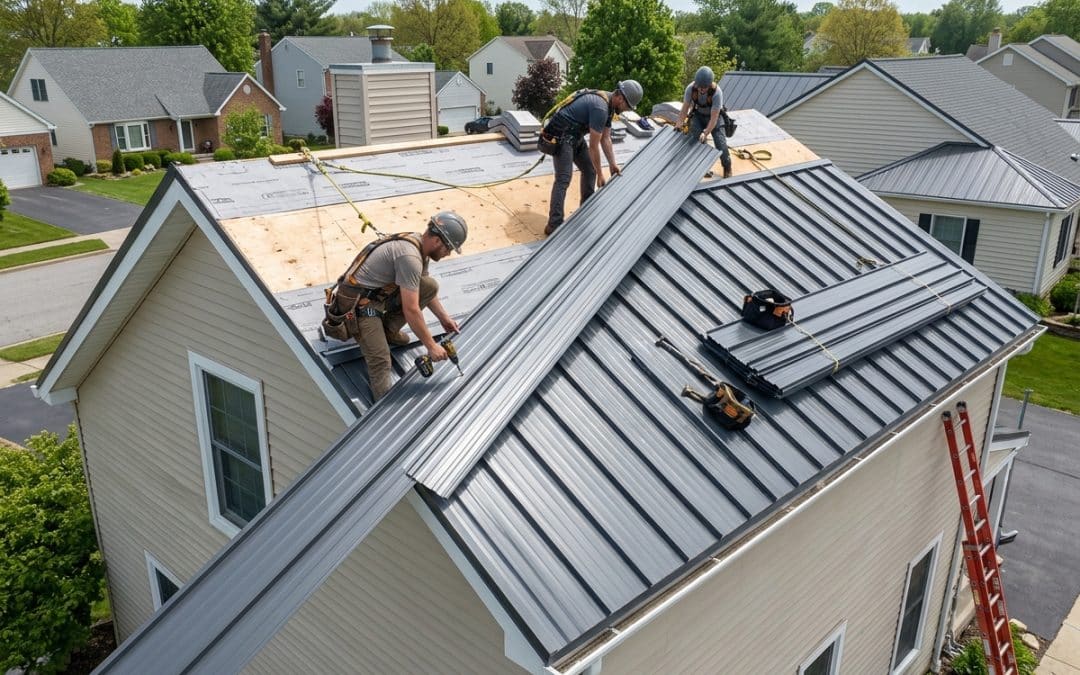
Where to Find Free Metal Roof Installation Diagrams (And What They Cover)
Free metal roof installation diagrams are available as downloadable PDFs directly from metal roofing manufacturers. Here are the best sources to get them:
- Classic Rib Install Guide – Metal Sales Manufacturing
- Architectural Standing Seam Install Guide – Best Buy Metals
- Exposed Fasteners Installation Guide – Magna Rib/Delta Rib panels
- Western States Metal Roofing – Offers free PDFs for 12+ panel types including 7/8″ Corrugated, PBR/R-Panel, and Standing Seam at their website
- FABRAL Distributors – Provide guides for 5 Rib, Grandrib 3, and Alu-Tuff panels through local distributors
Planning a metal roof project is exciting — but it’s also easy to get overwhelmed before you even pick up a screw gun.
The good news? Manufacturers publish detailed, free installation guides that include step-by-step instructions, flashing diagrams, load tables, and material estimating worksheets. These aren’t watered-down summaries. They cover everything from minimum roof pitch requirements to exactly how many screws you need per square foot.
The tricky part is knowing which guide matches your panel type — and understanding what the diagrams are actually telling you.
This guide pulls together the best free resources available, explains what each one covers, and walks you through the key installation concepts so you can use those diagrams with confidence.
Essential Tools, Safety, and Material Handling
Before you ever look at a free metal roof installation diagram, you need to have the right gear. Working with metal isn’t like working with asphalt shingles; it requires precision and a healthy respect for sharp edges.
The Right Tools for the Job
You’ll need a clutch-type screw gun with a depth-sensing nosepiece to ensure fasteners are seated perfectly—not too loose, and definitely not over-tightened. For cutting, we always recommend electric nibblers or metal shears. Avoid circular saws with standard blades; they create jagged, “burnt” edges that are prone to rust and throw hot metal filings onto your beautiful new finish. If you must use a saw, ensure it has a specific steel-cutting blade and clean up those shavings immediately!

Safety First
Safety isn’t just a suggestion; it’s a requirement. OSHA compliance is vital, especially regarding fall protection. When walking on your roof, always wear soft-soled shoes to provide grip and prevent scratching the panels. Metal is incredibly slippery when wet or even slightly dusty.
Handling and Storage
How you treat your panels before they go on the roof matters just as much as the installation itself.
- Elevate your bundles: Never store metal panels directly on the ground. Use blocks to keep them off the dirt and slope one end so moisture can drain off.
- Avoid “Wet Stack” Staining: If moisture gets trapped between stacked panels, it can cause permanent staining or corrosion. If they get wet, unstack them and dry them individually.
- Prevent Oil Canning: This is the wavy appearance sometimes seen in the flat areas of metal panels. While often considered a natural characteristic of roll-formed metal, handling panels carefully (carrying them on their edge rather than flat) can help minimize it.
For a deeper dive into these materials, check out our Comprehensive Guide to Residential Metal Roofing.
Preparing the Substrate and Underlayment
A great roof starts with what’s underneath. Whether you are building new or re-roofing over existing shingles, the “deck” must be solid and square.
Substrate Options
Most residential applications use solid plywood or OSB decking. However, in post-frame or agricultural buildings, you might be installing over “purlins” (horizontal wood strips). For 29-gauge 5 Rib panels, a common purlin spacing is 24 inches on center. If you are re-roofing over existing asphalt shingles, you can often do so if there is only one layer, but you must use underlayment or furring strips to create a flat, protective surface.
The 3-4-5 Triangle Method
Before laying your first panel, you must ensure the roof is square. We use the 3-4-5 method: measure 3 feet along the eave and 4 feet up the gable edge. If the diagonal distance between those two points is exactly 5 feet, you’re square! If not, you’ll need to adjust your panel alignment to prevent the roof from looking “crooked” as you reach the other side.
Underlayment Essentials
Modern metal roofs require high-quality synthetic underlayment. Because metal can reach high temperatures, your underlayment should be rated for at least 250°F.
- Ice and Water Shield: In the Salt Lake City area and throughout the Wasatch Front, we recommend a self-adhering ice and water shield at the eaves, valleys, and around chimneys to protect against ice dams.
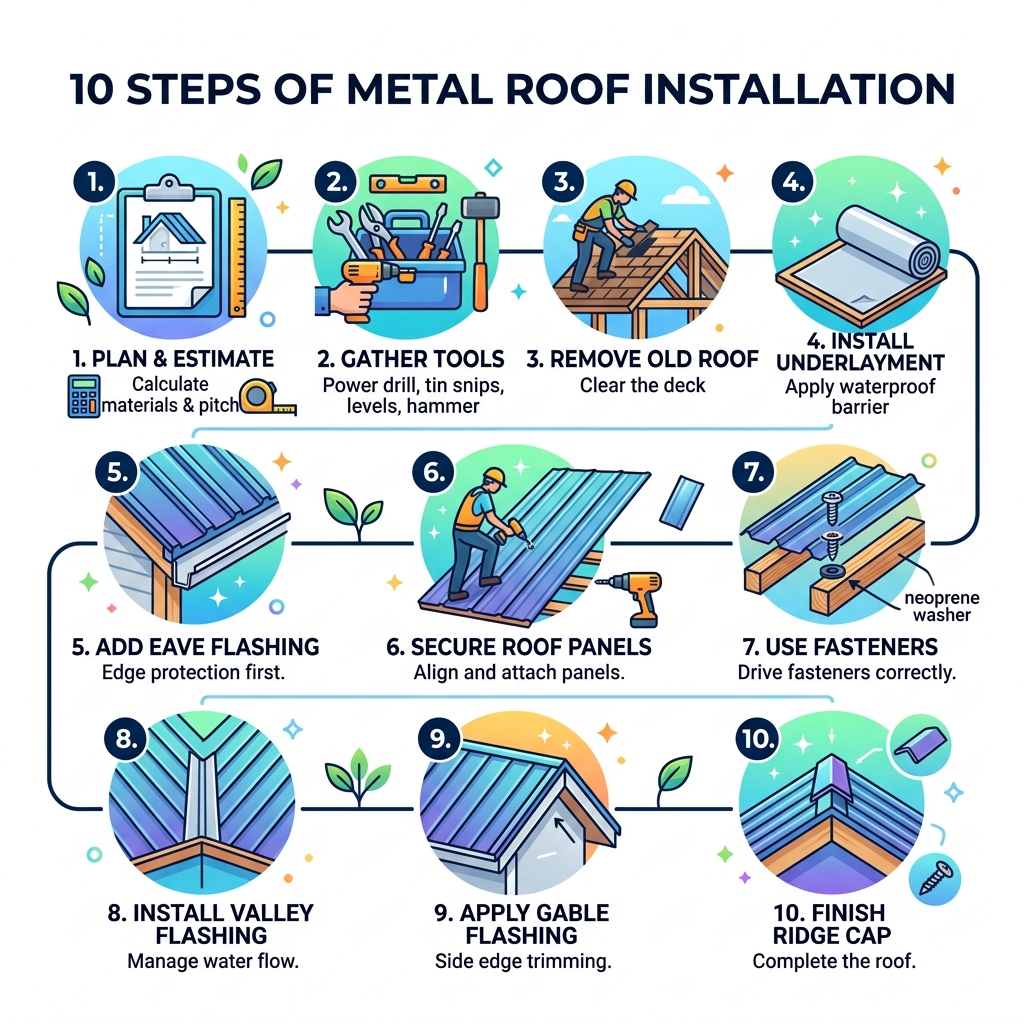
- Drip Edge: Install your eave trim (drip edge) first, before the underlayment, so the underlayment can lap over the top of the metal.
You can Watch How To Install Roofing Underlayment for a visual walkthrough of this process. Understanding these steps helps you know what to expect during the roof installation process.
Fastening and Overlapping Techniques for Different Roof Pitches
The “pitch” or slope of your roof dictates which panels you can use and how you must seal them.
| Panel Type | Minimum Pitch | Special Requirements |
|---|---|---|
| 5 Rib / Tuff-Rib | 2.5:12 | Below 4:12 requires butyl tape at laps |
| Corrugated | 3:12 | Standard for most residential sheds/barns |
| Standing Seam | 1:12 to 3:12 | Depends on rib height and seaming method |
| Classic Rib | 3:12 | Recommended for optimal drainage |
If your roof has a lower slope (between 2.5:12 and 4:12), you must apply butyl caulking or sealant tape at the end laps and side laps to prevent capillary action from pulling water under the panels.
Fastener Placement and Free Metal Roof Installation Diagram Patterns
Fastening is where most DIYers make mistakes. As a general rule, you will need about 80 to 100 screws per square (a 10′ x 10′ area).
In an exposed fastener system, like Tuff-Rib or 5 Rib, you should generally place screws in the “flat” part of the panel, right next to the rib. Never screw through the top of the rib unless the specific free metal roof installation diagram for your panel explicitly requires it. The neoprene washer on the screw should be compressed just enough to be flat, but not “mushroomed” or bulging.
Profile-Specific Free Metal Roof Installation Diagram Downloads
Each panel has a unique “personality.” A Classic Rib Install Guide will show different lap details than a Standing Seam Guide. Standing seam systems use hidden clips that allow for thermal expansion, meaning the metal can grow and shrink as temperatures change in the Utah sun without stressing the fasteners.
Installing Flashing and Special Roof Features
Flashing is the “armor” of your roof. It’s what keeps water out of the most vulnerable spots like valleys, chimneys, and ridges.
Flashing Details in a Free Metal Roof Installation Diagram
- Eaves and Gables: Eave trim goes on first. Gable (or rake) trim goes on after the panels are installed.
- Valleys: These should be lined with a wide “W-style” valley flashing. In snow-heavy areas like Park City or Alpine, we recommend an extra layer of ice and water shield underneath.
- Ridge Caps: For proper ventilation, we use vented closures. These allow air to escape from the attic while blocking snow and insects. A good vented closure provides about 9 sq. in. of net free air per lineal foot.
For more local tips, see our Utah Residential Metal Roofing Handbook.
Avoiding Common Mistakes
When looking at your free metal roof installation diagram, pay close attention to the “don’ts”:
- Don’t over-tighten screws: This destroys the seal and causes leaks.
- Don’t leave metal shavings: These will rust and pit your paint.
- Don’t walk on the ribs: Only walk in the flat areas between the ribs to avoid denting the metal.
- Don’t forget the sealant: Butyl tape is your best friend at transitions and end laps.
Where to Download Your Free Metal Roof Installation Diagram
Ready to get started? Most manufacturers provide comprehensive “Self-Help” guides. These often include:
- Bird’s-eye view diagrams: To help you sketch your roof.
- Panel cut lists: To calculate exactly how many 36-inch wide panels you need.
- Fastener calculators: To help you order the right amount of screws.
For example, if you have a 25-foot ridge, and each panel covers 36 inches (3 feet), you’ll need 9 panels per side (25 ÷ 3 = 8.33, rounded up).
Frequently Asked Questions about Metal Roof Installation
What is the minimum roof pitch for metal panels?
For most exposed-fastener panels like 5 Rib or Tuff-Rib, the minimum pitch is 2.5:12. For standing seam, it can be as low as 1:12 depending on the specific profile. Always check your specific free metal roof installation diagram before ordering.
Can I install a metal roof over existing shingles?
Yes, in many cases you can! It’s a great way to save on tear-off costs. However, you must ensure the existing roof is in decent shape (no rot) and use a proper underlayment or furring strips to separate the new metal from the old shingles.
How many screws do I need per square of metal roofing?
Plan for 80 to 100 screws per square (100 square feet). If you have a 1,500-square-foot roof, you’ll likely need between 1,200 and 1,500 screws. It’s always better to have a few extra!
Conclusion
Taking on a DIY metal roofing project is a big task, but with the right free metal roof installation diagram and a bit of patience, it’s entirely doable. By following manufacturer guidelines, prioritizing safety, and using the right tools, you can install a roof that lasts 40 to 50 years.
However, we know that life gets busy and roof pitches can be steep! If you decide you’d rather have the pros handle it, Heaton Bros. Roofing is here to help. As a 4th-generation, family-owned company based in Salt Lake City, we’ve been serving the Wasatch Front for over 65 years. From Draper to Logan and everywhere in between, we provide reliable, affordable service you can trust.
Contact Heaton Bros. Roofing for Professional Installation Services today for a free estimate or to discuss your next project!