Why Asphalt Shingle Roofers Matter for Your Home
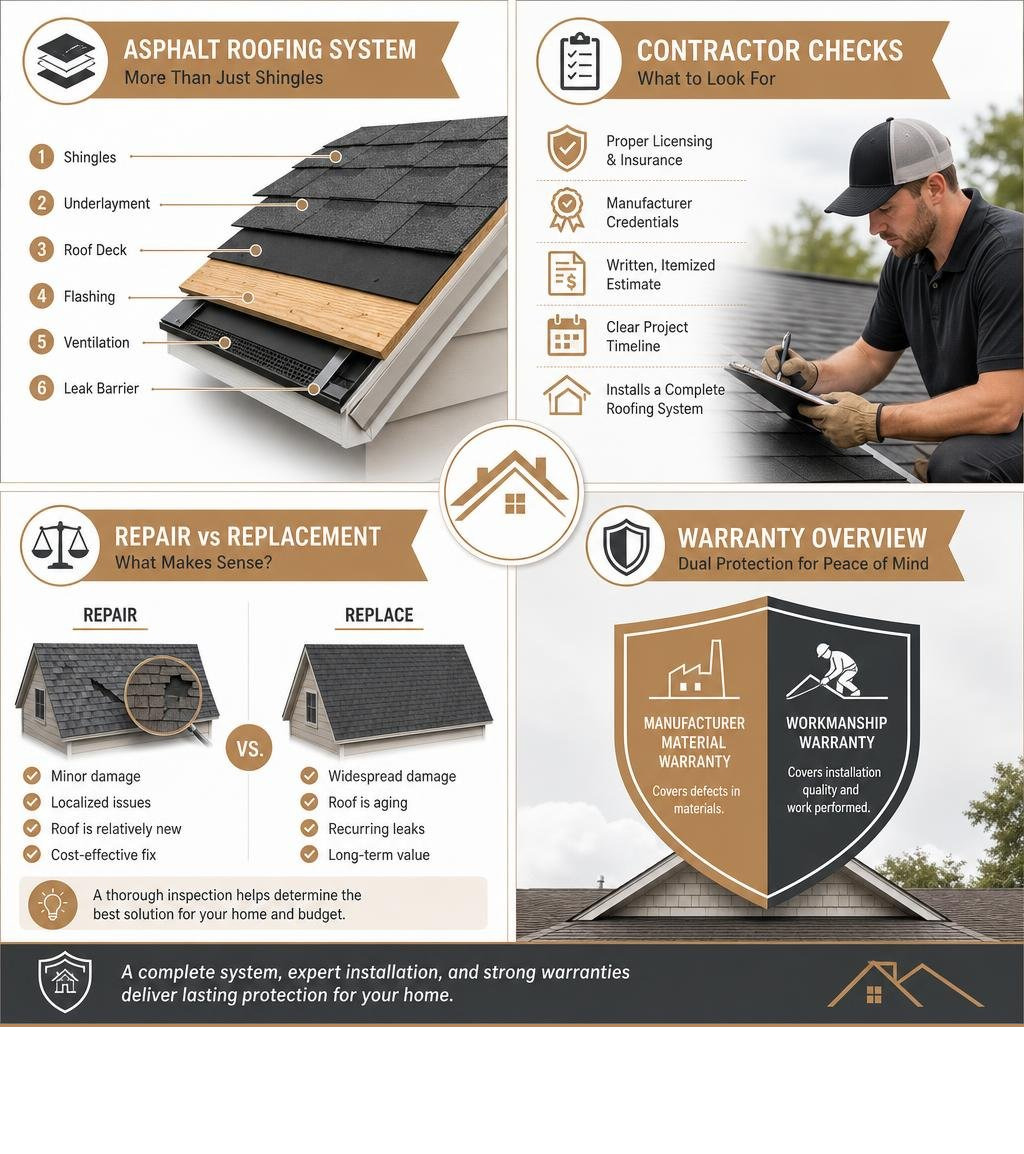
Asphalt shingle roofers inspect, repair, and replace one of the most common roofing materials in North America. A qualified roofer does more than install visible shingles: they evaluate the roof deck, underlayment, flashing, leak barriers, ventilation, and other details that help protect your property from Utah’s sun, wind, snow, and storms.
For a quick answer, choose a roofing contractor who can:
- Explain whether repair or replacement makes the most sense.
- Provide a written, itemized estimate and clear project timeline.
- Show proof of insurance, licensing requirements, and manufacturer credentials.
- Install a complete roofing system, not shingles alone.
- Offer both a manufacturer material warranty and a workmanship warranty.
Asphalt shingles come in several grades, from affordable 3-tab products to thicker architectural and designer shingles. The best choice depends on your roof’s condition, local weather exposure, the look you want, and your budget.
At Heaton Bros. Roofing, we provide straightforward roof repairs, storm-damage assessments, and full asphalt shingle replacements throughout the Salt Lake City area. As experienced asphalt shingle roofers, we focus on honest guidance, reliable timelines, and installation methods built for long-term protection.
Asphalt shingle roofers terms you need:
Types of Asphalt Shingles and Roofing System Components
When homeowners start exploring roof replacements across Salt Lake City and the Wasatch Front, they quickly realize that not all asphalt shingles are created equal. Asphalt shingles remain the dominant choice for residential properties because they strike an ideal balance between affordability, aesthetic versatility, and rugged weather performance. However, picking the right product requires understanding how different asphalt shingle styles are manufactured and how they operate on your roof.
Every quality asphalt shingle is constructed using a multi-layer engineering process:
- Fiberglass Mat: The structural core of the shingle that gives it tear strength and flexibility.
- Asphalt Coating: Water-resistant asphalt coats both sides of the fiberglass mat to keep rain and melting snow out of your home.
- Mineral Fillers and Stabilizers: Ingredients blended into the asphalt layer to enhance fire resistance and weather stability.
- Ceramic-Coated Granules: Hard mineral granules embedded on the top surface protect the underlying asphalt from harsh ultraviolet (UV) radiation, give the shingle its rich color, and often contain algae-resistant copper formulas.
- Back Surfacing: Fine silica or mineral material applied to the underside to prevent shingles from sticking together in storage or transport.
To explore all materials in detail, check out The Complete Guide to Roofing Materials.
Here is how the three primary types of asphalt shingles compare against one another:
| Shingle Category | Structural Profile | Estimated Lifespan | Wind & Weather Resistance | Aesthetic Appeal |
|---|---|---|---|---|
| 3-Tab Shingles | Single-layer lightweight profile with uniform cutouts | 15 – 20 Years | Standard (Up to 60 mph wind ratings) | Traditional, flat, uniform pattern |
| Architectural (Dimensional) Shingles | Multi-layer laminated structure with dimensional depth | 25 – 30+ Years | High (Up to 110 – 130 mph wind ratings) | Modern, textured, shadow-line appearance |
| Designer (Luxury) Shingles | Extra thick multi-layer construction custom-cut | 30 – 50 Years | Superior (UL 2218 Class 4 impact resistance available) | Mimics natural slate or hand-split wood shakes |
- 3-Tab Shingles: The traditional entry-level option. Built as a flat, single layer with cutouts that create the visual illusion of three separate tabs. While extremely cost-effective for tight budgets or rental units, they lack the wind resistance and longevity needed for areas prone to heavy canyon winds or intense mountain snowfall.
- Architectural Shingles: The modern industry benchmark. Laminated with multiple layers of asphalt and fiberglass, architectural shingles provide a rich, dimensional texture that hides slight roof deck imperfections while offering superior wind uplift resistance.
- Designer Shingles: Crafted for custom aesthetics, designer shingles provide striking shadow lines and geometric shapes that replicate authentic slate tiles or heavy wood shakes without requiring expensive structural reinforcement.
Essential Components of a Complete Roofing System
Replacing a roof involves far more than simply nailing down colorful top shingles. Trusted asphalt shingle roofers install an integrated defense system where every single layer supports the next.

- Starter Strip Shingles: Installed along the eaves and rake edges of the roof deck before main shingles are applied. Starter strips feature factory-applied adhesive strips that bind the bottom edge of the roof against severe wind uplift.
- Ice and Water Leak Barrier: A self-adhering waterproof membrane applied directly to vulnerable areas such as roof valleys, around chimneys, and along lower roof edges. In Northern Utah winters, ice dams can force melting snow backward underneath shingles; an ice barrier seals tightly around nail penetrations to keep interior ceilings dry.
- Underlayment Protection: A water-resistant synthetic or asphalt-saturated felt sheet installed across the entire bare roof deck before shingles go down. It serves as a vital secondary defense barrier against wind-driven rain.
- Ridge Cap Shingles: Specially designed shingles installed along the highest peaks and hip lines of your roof. They wrap cleanly over roof joins and house essential ridge exhaust vents while giving the home a polished architectural finish.
- Attic Ventilation System: Balanced attic intake vents (located under the soffits or eaves) and exhaust vents (located near or along the ridge cap) keep air flowing continuously through the attic space. Proper airflow exhausts excess summer heat and winter moisture, protecting your roof structure from early thermal degradation and preventing structural ice dam formation.
Asphalt Shingle Roof Lifespan, Durability, and Replacement Costs

Understanding the long-term ROI of an asphalt shingle installation requires evaluating material ratings, physical durability standards, and actual market pricing.
When evaluating asphalt shingle durability, industry standards help predict how well your roof will handle atmospheric stress:
- Wind Resistance: Tested under standard guidelines such as ASTM International D3161 Class F or ASTM D7158 Class H, top architectural asphalt shingles withstand fan-induced winds and uplift forces up to 130 miles per hour.
- Impact Resistance (UL 2218): Underwriters Laboratories) developed the UL 2218 standard to test shingle impact strength by dropping 2-inch steel balls twice onto the same spot from a height of 20 feet. Shingles earning a Class 4 rating—the highest available—show zero visible cracking on the backing material, proving their ability to endure severe hail storms.
- Fire Resistance: Modern fiberglass asphalt shingles achieve a Class A fire rating under UL 790/ASTM E 108 standards, offering maximum external flame-spread protection for your home.
When budgeting for a roof installation, contractors measure roof area in “roofing squares.” One roofing square equals exactly 100 square feet of finished roof surface area. Industry wide, national statistics showed the average cost of a standard residential roof replacement in 2025 reached $17,631.
Actual project costs in 2026 vary based on several site-specific variables:
- Roof Surface Area and Pitch: Larger or steeper roofs require additional safety equipment, specialized staging, and increased labor hours.
- Material Selection: Moving from standard 3-tab to high-performance architectural or Class 4 impact-resistant shingles increases upfront material expenditure while boosting long-term value.
- Tear-Off and Decking Repairs: Removing multiple existing roof layers or replacing rotted plywood decking beneath old roof leaks increases labor and disposal costs.
- Architectural Complexity: Dormers, skylights, valleys, and chimneys require extra flashing detailing and ice barrier protection.
To understand why paying for experienced craftspeople protects your wallet over time, read our article on Why Professional Roof Installation Saves You Money in the Long Run.
Evaluating Repair vs. Full Replacement
Homeowners often ask whether an aging or damaged roof can simply be patched, or if a complete tear-off and replacement is necessary. Knowing what to look for helps prevent small problems from turning into costly interior water damage.
Signs that call for a focused roof repair:
- Isolated wind damage where only a few shingles were lifted or blown off during a single severe canyon wind event.
- A localized pipe boot failure or small flashing leak around a vent pipe that can be resealed or replaced quickly.
- Minor physical damage restricted to a single, isolated section of an otherwise young roof (under 10 years old).
Signs that indicate it is time for a full roof replacement:
- Extensive Granule Loss: Large patches of smooth, bald asphalt exposed on shingles, or gutter downspouts constantly clogging with dense protective granules.
- Curling, Cupping, or Clawing Shingles: Age-related loss of volatile oils causes shingle edges to curl upward or middle sections to cup downward, exposing the roof structure to driving rain.
- Widespread Structural Sagging: Wavy rooflines or dipping plywood deck panels caused by chronic moisture infiltration or inadequate attic support.
- Advanced Roof Age: Standard architectural roofs approaching 20 to 25 years of age generally require full replacement to maintain insurance eligibility and full weatherproofing.
For a deeper dive into diagnosing structural damage, consult our guides on Signs You Need Roof Repair or Replacement and Roof Replacement vs Repair How to Decide.
How to Hire Qualified Asphalt Shingle Roofers

Roofing consistently ranks among the top consumer service industries for complaints when unvetted or unlicensed contractors enter local markets. Choosing the right asphalt shingle roofers ensures your project goes smoothly from start to finish.
Before signing any agreement, verify that your chosen roofing contractor meets essential security standards:
- Comprehensive Insurance Coverage: Request active certificates for both General Liability Insurance (to cover accidental property damage) and Workers’ Compensation Insurance (to protect you from personal liability if an installer is injured on your property).
- Direct Staffing Standards: Ask whether the contractor relies entirely on direct, hourly employees or hands the work off to unvetted third-party subcontractors. Direct employees deliver consistent craftsmanship and direct project oversight.
- Property Protection Protocols: Professional crews use tarping systems, plywood shields over windows and landscaping, and magnetic rollers to collect fallen nails continuously during tear-offs.
To learn more about vetting contractors in your immediate area, view our step-by-step checklist on How to Find a Reliable Roofing Contractor in Your Area.
Essential Questions to Ask Asphalt Shingle Roofers
When interviewing prospective contractors, clear communication eliminates costly surprises. Bring these crucial questions to your initial consultation:
- “Will you provide a fully detailed, itemized written proposal?” Avoid vague one-line estimates. A professional proposal specifies exact brand names, shingle line colors, underlayment types, ventilation specs, and disposal fees.
- “Do you guarantee your pricing against unexpected change orders?” Trustworthy contractors perform precise upfront deck measurements so pricing remains fixed unless hidden structural rotted decking is uncovered during tear-off.
- “Will there be a designated, full-time onsite foreman managing my job continuously?” Having a knowledgeable supervisor on site from start to finish ensures strict compliance with safety rules and manufacturer installation instructions.
- “Will you pull all required local building permits before work begins?” Legitimate local contractors post proper municipal permits prominently on site before dropping off materials or setting up ladders.
- “How do you handle trash containment and daily cleanup?” Inquire about dumpsters, magnetic sweep passes, and ground protection to keep driveways and yards clean throughout construction.
Review our dedicated post on The Top 8 Questions to Ask Your Roofing Contractor Before Hiring to prepare your interview list.
Verifying Credentials of Local Asphalt Shingle Roofers
Don’t just take a contractor’s word for it—verify their track record independently:
- Check State Licensing Portals: Confirm that the contractor holds an active, unblemished specialty roofing license with state licensing boards (such as the Utah Division of Professional Licensing).
- Examine Manufacturer Certifications: Top asphalt shingle manufacturers grant advanced certifications—such as GAF Master Elite status, which is achieved by only 2% of roofers nationally—to contractors who meet rigorous training, installation, and financial stability standards. These credentials unlock exclusive, long-term manufacturer warranty coverage for homeowners.
- Evaluate Real Client Feedback: Read recent online reviews across Google and business rating portals. Look for recurring praise regarding punctuality, cleanliness, prompt communication, and post-installation support.
Understanding Roof Warranties and Long-Term Maintenance
A new asphalt shingle roof represents a major investment, and understanding your warranty coverage gives you long-term peace of mind. Roof coverage is divided into two distinct warranties:
- Manufacturer Material Warranty: Covers manufacturing defects that cause premature shingle degradation or product failure. Standard warranties typically last 20 to 50 years (often branded as “lifetime” warranties for single-family homes). Enhanced system warranties covered by factory-certified installers can also include non-prorated material replacement periods up to 50 years.
- Contractor Workmanship Warranty: Covers errors made during installation, such as improper nail placement, misaligned starter strips, or poorly sealed flashing connections. Quality contractors back their craftsmanship with direct warranties ranging from 5 to 25+ years.
Proper routine maintenance keeps both warranties intact and maximizes the working lifespan of your roof:
- Clean Gutters and Downspouts: Clear leaves, twigs, and dirt build-up each spring and fall to prevent rainwater from backing up under lower roof edge shingles.
- Remove Organic Roof Debris: Gently clear accumulated pine needles and leaf clusters from roof valleys and behind chimneys where trapped moisture can rot shingles.
- Trim Overhanging Tree Branches: Keep tree limbs trimmed back at least 6 to 10 feet from roof surfaces to prevent physical abrasion during windstorms and reduce shade that promotes moss growth.
- Schedule Professional Inspections: Have certified asphalt shingle roofers perform visual inspections after severe wind, hail, or winter ice storms to catch subtle flashing tears or lifted shingles early.
For custom seasonal checklists and preventative guidance, browse our complete guide on Roof Maintenance 101 Tips from Your Local Roofing Company.
Frequently Asked Questions About Asphalt Shingle Roofing
How much does a new asphalt shingle roof cost in 2026?
Average residential roof replacement costs across the region generally fall between $9,000 and $22,000+, depending on total square footage, roof pitch, material selection (such as standard architectural versus high-end designer shingles), tear-off complexity, and local labor rates.
How long do asphalt shingle roofs typically last?
A professionally installed architectural asphalt shingle roof in Northern Utah typically lasts between 25 and 30 years. Lifespan is heavily influenced by balanced attic ventilation, climate exposure, and regular preventative maintenance. Traditional 3-tab roofs usually last 15 to 20 years, while premium luxury shingles can reach 30 to 50 years.
What are Class 4 impact-resistant shingles?
Class 4 impact-resistant shingles undergo rigorous UL 2218 laboratory testing, where 2-inch steel balls are dropped twice onto the same spot from a height of 20 feet without fracturing the shingle substrate. These shingles provide exceptional resistance against severe hail damage, and many home insurance providers offer policy discounts when they are installed.
Conclusion
Choosing the right roofing material and working with qualified asphalt shingle roofers ensures your home stays protected through intense summer sun, dry winds, heavy autumn rains, and severe winter snow loads. By choosing high-performance architectural shingles and installing a complete system—including underlayment, ice barriers, starter strips, and balanced attic ventilation—you protect your property and boost its curb appeal for decades to come.
With over 65 years of hands-on experience spanning four generations, our team at Heaton Bros. Roofing takes pride in delivering exceptional craftsmanship, clear communication, and reliable service across Salt Lake City and the Wasatch Front. Whether you need a simple roof inspection, prompt leak repair, or a full system replacement, we are here to help.
Ready to protect your home with confidence? Explore Our Professional Roofing Services today to request your complimentary, no-obligation roof consultation!