
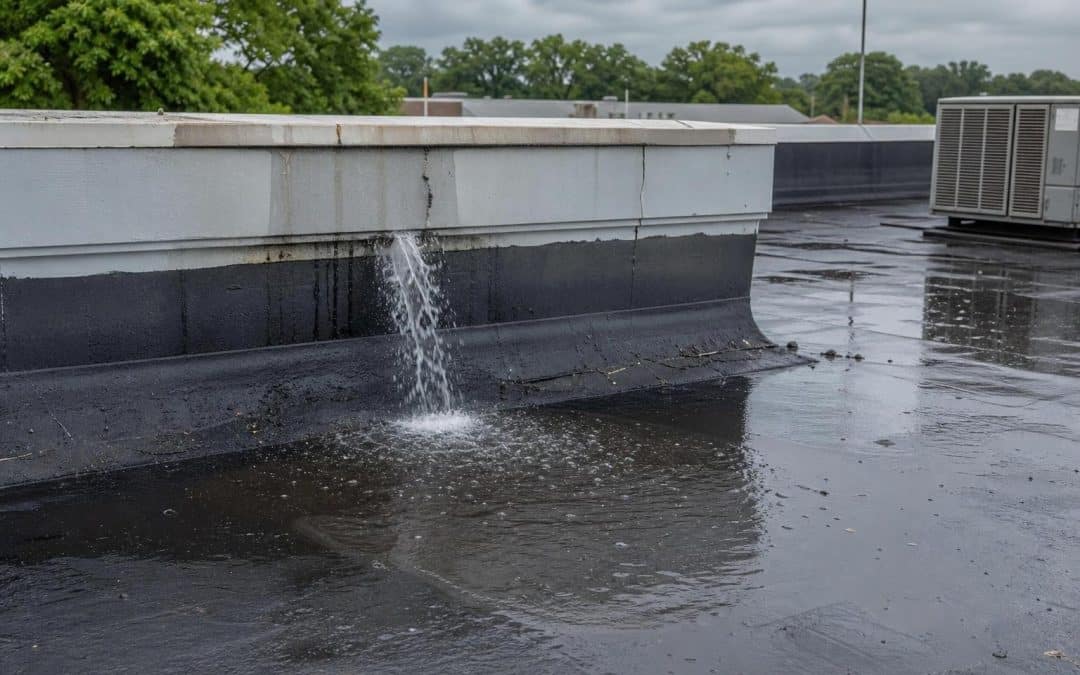
When Your Flat Roof Is Leaking Right Now: What to Do First
If you’re dealing with an emergency flat roof repair, here’s what to do immediately:
- Move valuables away from the leak area
- Place buckets or towels to contain water
- Take photos and video of all visible damage — you’ll need this for insurance
- Do not climb on the roof during active rain or wind
- Call a professional roofer — flat roof leaks spread fast and can double in damage within hours
A small drip in the morning can mean soaked insulation, ruined inventory, or collapsed ceiling tiles by nightfall. Flat roofs hide damage beneath their surface — water can travel 20 feet or more from the actual breach before it shows up inside. That’s what makes flat roof leaks so dangerous: by the time you see it, the problem is already bigger than it looks.
At Heaton Bros. Roofing, we’ve helped Utah homeowners and small business owners respond to urgent roof failures across the Salt Lake City area — including flat roof crises that couldn’t wait for a regular appointment. When it comes to emergency flat roof repair, we take a straightforward, no-pressure approach so you get the right fix fast, without overpaying.
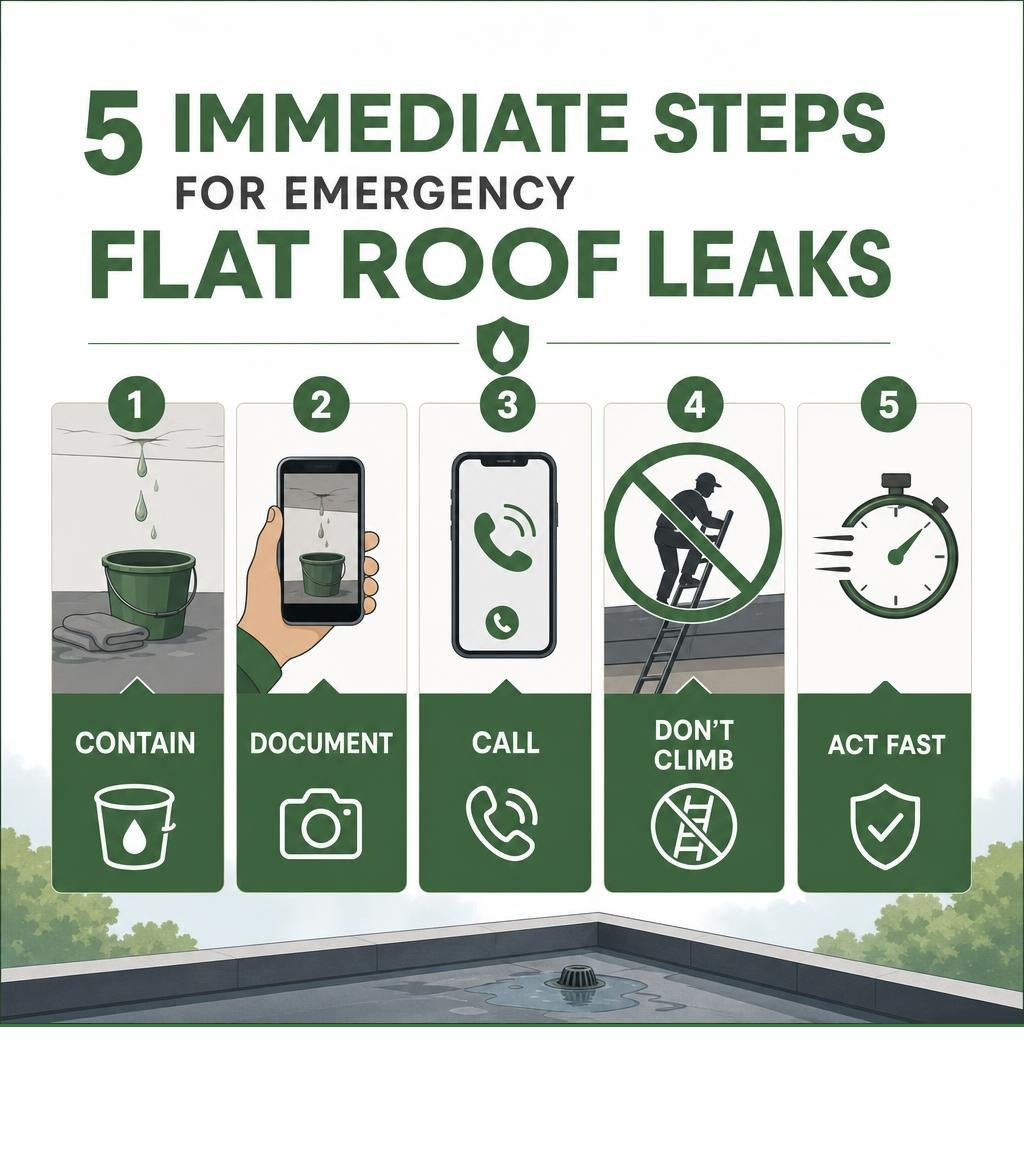
Emergency flat roof repair terms you need:
What Qualifies as an Emergency Flat Roof Repair?
Not every flat roof issue requires a frantic, middle-of-the-night phone call. If you notice a tiny spot of discoloration on an upper-floor ceiling during a light drizzle, it certainly needs attention, but it can usually wait for a scheduled inspection during business hours.
However, a true emergency flat roof repair situation is one that compromises the safety, structural integrity, or immediate functionality of your property. If water is actively pouring into your living space or commercial inventory, that is an emergency. Similarly, if a severe storm has torn away sections of your roofing membrane, or if a fallen tree limb has punctured the roof deck, you cannot wait.
On flat and low-slope systems, which are highly common on commercial buildings and modern multifamily apartment complexes along the Wasatch Front, water behaves differently than it does on pitched shingle roofs. Gravity doesn’t pull water off a flat roof; instead, the roof relies on a subtle slope toward drains and scuppers. When that drainage fails or the membrane is breached, standing water becomes a major structural risk.
If left unaddressed, ponding water will find the path of least resistance, soaking through your insulation, rotting the wooden roof decking, and potentially leading to a sudden ceiling collapse. To prevent these catastrophic outcomes, understanding how to protect your home from sudden weather events is crucial. You can read more info on storm damage to understand how severe weather directly impacts flat roof structures.
Immediate Steps to Take During an Active Leak
When water is actively entering your building, panic is your worst enemy. Taking systematic, calm steps will save you thousands of dollars in secondary structural repairs and interior damage.
First, focus on containment. Place heavy-duty plastic buckets under the drip. If water is pooling on a plaster ceiling or drywall, you may actually want to poke a small hole in the center of the sagging area with a screwdriver to channel the water into a single bucket. This prevents the water from spreading horizontally and collapsing a larger section of the ceiling.
Second, document everything. Take clear, well-lit photos and videos of the active drip, any pooling water on your floors, damaged ceiling tiles, and affected belongings. Note the exact time the leak started and what the weather conditions were like outside. This documentation is absolute gold when you file your insurance claim later.
Third, call us for emergency dispatch. While you wait for our crew to arrive, keep your family or tenants safe by keeping them away from the affected area. Do not attempt to go up on the roof yourself while it is raining, snowing, or blowing hard. Flat roofs become incredibly slick when wet, and wind gusts along the Wasatch Front can easily cause a fall. For a deeper look at managing these stressful situations, check out our guide on how to handle storm damage like a seasoned professional.
The Dangers of DIY Emergency Flat Roof Repair
It is incredibly tempting to run to the nearest big-box hardware store, grab a tub of cheap roof mastic or a can of spray sealant, and try to patch the leak yourself. We completely understand the urge to save a buck, but DIY flat roof patching carries massive risks that often cost far more in the long run.
The most immediate risk is personal safety. Navigating a wet, damaged flat roof without commercial safety gear is a recipe for disaster. Beyond the physical danger, DIY repairs can easily void your existing roof manufacturer warranty. Many high-quality single-ply membranes (like TPO or EPDM) require specific, certified installation and repair methods. If a manufacturer sees that an unapproved, off-the-shelf chemical or adhesive was applied to their membrane, they may completely void your warranty coverage.
Furthermore, using improper materials can actually degrade your roof. For example, applying typical asphalt-based roof cement to a TPO or EPDM rubber roof can chemically break down the synthetic membrane, transforming a small puncture into a massive, melted chemical mess. Cheap aerosol sealants also fail rapidly under UV exposure and ponding water, giving you a false sense of security while water continues to rot your roof deck from the inside out. For a breakdown of safe, effective flat roof maintenance, see our comprehensive guide to flat roof fixes.
How Professionals Locate and Patch Flat Roof Breaches
One of the most frustrating aspects of flat roof leaks is that water rarely drips straight down from the hole in the membrane. Because flat roofs have a very slight slope and are built with multiple layers (membrane, cover board, insulation, vapor barrier, and wood or metal decking), water can enter a small tear on one side of the building, migrate laterally along the metal deck or joists for 20 or 30 feet, and finally drip into your room on the opposite side of the building.
To find the actual source of the leak, our professional crews don’t just guess. We use advanced diagnostic tools:
- Thermal Imaging Cameras: Wet insulation holds heat differently than dry insulation. By scanning your roof after sunset, we can see the exact thermal signature of trapped water beneath the membrane, tracing the moisture path directly back to the entry point.
- Moisture Meters: These specialized meters allow us to measure the moisture content of the roofing layers without puncturing the membrane, confirming where the water is concentrated.
- Visual Forensic Audits: We inspect high-risk areas within a 10-to-20-foot radius of the interior drip, looking for split seams, cracked flashing around HVAC units, and clogged drains.
Once we locate the breach, we must decide between a temporary emergency patch or a permanent repair. Here is how those two approaches compare:
| Feature | Temporary Emergency Patch | Permanent Flat Roof Repair |
|---|---|---|
| Primary Goal | Stop active water intrusion immediately | Restore long-term structural integrity |
| Materials Used | Emergency mastic, temporary tarps, peel-and-stick tape | Heat-welded membrane patches, matching commercial primers |
| Weather Conditions | Can be applied in rain, snow, or cold weather | Requires dry, clean, and warm conditions |
| Expected Lifespan | A few weeks to a couple of months | Years (often matching the remaining life of the roof) |
| Warranty Impact | Does not guarantee warranty compliance | Done to manufacturer specs to preserve warranties |
Our professional emergency flat roof patching protocols ensure that even if we have to apply a temporary fix in the middle of a winter storm, we do so using compatible, high-grade emergency materials that won’t ruin your roof’s chemistry.
Material-Specific Techniques for Emergency Flat Roof Repair
Different flat roof membranes require completely different repair strategies. A technique that works beautifully on one roof will fail catastrophically on another.
TPO (Thermoplastic Polyolefin)
Thermoplastic Polyolefin (TPO) is a popular, white single-ply membrane known for its energy efficiency. The permanent way to repair TPO is through heat-welding. Our crews use specialized hot-air welders that heat the membrane and the patch to around 500°F, fusing them together into a single, continuous sheet. However, during an active rainstorm, heat-welding is impossible because the water cools the welder instantly. For emergency TPO repairs in wet weather, we clean the area, dry it as much as possible, apply a specialized TPO primer, and install a heavy-duty, self-adhering TPO patch tape.
EPDM (Ethylene Propylene Diene Monomer)
EPDM rubber is a synthetic black rubber membrane. Unlike TPO, EPDM cannot be heat-welded; it relies on chemical adhesives and seam tapes. For an emergency EPDM patch, we clean the membrane of dirt and carbon buildup (which naturally accumulates on rubber), apply a specific EPDM primer, and roll out a professional peel-and-stick EPDM patch. We use a heavy steel roller to ensure a tight, bubble-free bond.
Modified Bitumen
Modified bitumen roofs are asphalt-based and often have a granulated surface. In dry weather, these are typically repaired using a torch-down method, melting a new piece of asphalt membrane over the damage. In an emergency wet-weather scenario, we use specialized, rubberized wet-surface mastics. These heavy-duty mastics are formulated to displace water, allowing them to stick to wet surfaces and seal the breach until dry weather allows for a permanent torch-down repair.
Because choosing the wrong technique can destroy your roof, it is highly recommended to leave these tasks to certified professionals. You can learn more about finding the right team by reading our guide on choosing a flat roof specialist.
The Role of Ponding Water and Humidity in Flat Roof Failures
Ponding water is defined as water that remains on a flat roof for more than 48 hours after a rainstorm or snowmelt. It is the single greatest enemy of any flat roof system.
When water sits on a roof for extended periods, it puts immense hydrostatic pressure on the seams and flashing. Over time, this standing water will break down the adhesives holding the seams together, leading to slow, hidden leaks. Additionally, ponding water acts like a magnifying glass under the hot Utah sun, concentrating UV rays and accelerating the degradation of the membrane beneath it.
Here in the Salt Lake City area and along the Wasatch Front, our unique climate poses severe challenges for flat roofs. We experience dramatic temperature swings — sometimes 40 degrees or more in a single 24-hour period. This causes rapid thermal expansion and contraction.
During the winter, water can seep into a tiny crack in a roof seam during a sunny afternoon melt. Overnight, as temperatures plunge below freezing, that water turns to ice and expands, popping fasteners loose and tearing the seam wide open.
In the spring and summer, our high humidity and sudden downpours can keep moisture trapped inside saturated roof insulation. This trapped moisture cannot escape, leading to rapid rot of your wooden roof deck and creating a perfect breeding ground for mold and mildew within your ceiling cavity.
Costs, Codes, and Insurance for Urgent Roof Fixes
When a roofing emergency strikes, the first question on every property owner’s mind is: What is this going to cost me?
Emergency services naturally carry a premium because they require rapid dispatch, often after-hours or during severe weather. A basic emergency tarping or temporary mastic patch service typically ranges from $300 to $900, depending on the size of the leak, ease of access, and weather conditions.
If the damage is localized, a permanent professional repair can range from $500 to $3,500. However, if the roof is near the end of its 20-to-30-year lifespan and has suffered widespread failure, a full replacement may be required.
To help you navigate this financial decision, we have put together a detailed resource on deciding between repair and replacement.
Local building codes and insurance policies also play a major role in emergency repairs. Along the Wasatch Front, building codes dictate how many layers of roofing can exist on a structure (usually a maximum of two) and specify required drainage rates.
When it comes to insurance, most commercial and homeowner policies treat emergency mitigation (like temporary tarping or patching) as a mandatory step. In fact, most policies have a “loss mitigation” clause that requires you to take immediate action to prevent further damage to the property.
Because of this, insurance carriers will almost always reimburse the cost of professional emergency patching, provided you have documented the damage with clear photos and kept your professional invoices. We work directly with insurance adjusters weekly, providing the detailed photo reports and written assessments they need to process your claim quickly.
Frequently Asked Questions About Urgent Roof Leaks
Navigating an active leak is stressful, and we hear many of the same questions from worried property owners. Here are the clear, honest answers you need right now.
How quickly will an emergency flat roof repair crew arrive after calling?
At Heaton Bros. Roofing, we prioritize active interior leaks and storm damage over routine maintenance. When you call us with an active flat roof emergency along the Wasatch Front, our goal is to have a diagnostic crew on-site as quickly as possible—often within a few hours, depending on the severity of the ongoing weather event.
We maintain fully stocked emergency service trucks ready to deploy so we can contain the leak on our very first visit. For more details on our localized response, you can read about our emergency roof repair in Salt Lake City.
What are the most common causes of flat roof leaks in Charlotte’s climate?
While our primary focus is serving our neighbors along the Wasatch Front in Utah, we often look at how different climates affect commercial building stock. In humid, storm-heavy regions like Charlotte, flat roofs fail primarily due to intense humidity, clogged internal drains, and severe ponding water from heavy summer downpours.
In contrast, our Utah flat roofs face a brutal combination of heavy winter snow loads, rapid freeze-thaw cycles that split seams overnight, and intense high-altitude UV radiation that dries out and cracks older membranes. Regardless of the region, the root causes remain similar: thermal expansion, standing water, and neglected maintenance.
How long does a professional emergency flat roof repair patch last?
A professional emergency patch is designed to be a highly effective stopgap, not a permanent solution. An emergency mastic or temporary tape patch applied during a storm can easily hold water out for several weeks or even a few months.
However, you should always schedule a permanent repair as soon as dry, warm weather permits. Leaving a temporary patch in place indefinitely is a major risk, as it will eventually degrade under UV exposure and ponding water. To help you spot when a temporary fix is reaching its limit, read our guide on the signs you need repair or replacement.
Conclusion
When water is pouring through your ceiling, you don’t need a high-pressure sales pitch — you need a fast, reliable solution from a team you can trust. At Heaton Bros. Roofing, we are a 4th-generation, family-owned company with over 65 years of experience serving Salt Lake City and the surrounding Wasatch Front communities. We pride ourselves on providing honest assessments, quality craftsmanship, and affordable rates.
Don’t let a small leak turn into a structural disaster. If you are facing a flat roof crisis or want to schedule a preventive inspection to avoid one, contact us today to schedule professional roofing services with our friendly, experienced team. We are here to keep you dry, warm, and protected.