
Why Finding the Right Flat Roof Repair Specialists in Utah Can Save You Thousands
If you’re looking for flat roof repair specialists utah property owners trust, here are the most important things to know right away:
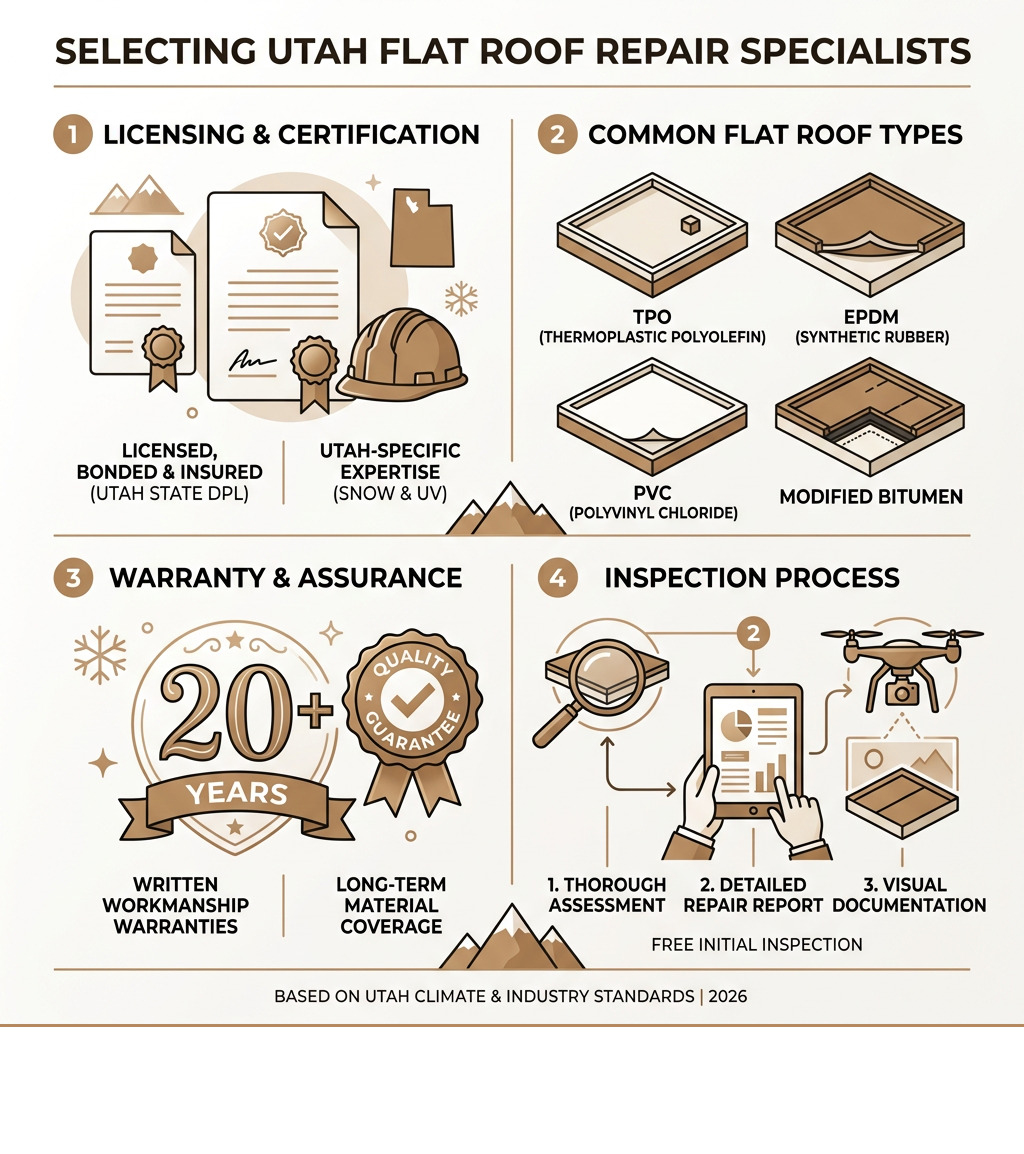
Top qualities to look for in a Utah flat roof repair specialist:
- Licensed, bonded, and insured – protects you if something goes wrong
- Experience with Utah’s climate – heavy snow, hail, and intense UV require local know-how
- Familiar with all major flat roof systems – TPO, EPDM, PVC, Modified Bitumen, and BUR
- Offers free inspections – reputable specialists assess before they quote
- Provides written warranties – up to 20 years on quality work
- Insurance claim assistance – especially important after Utah hailstorms
Flat roofs are common across Utah – on homes, apartments, commercial buildings, and condos. But they face serious punishment from the state’s climate: brutal winter snowpack, freeze-thaw cycles, hail that can punch right through a membrane, and summer UV exposure that degrades materials fast.
The stakes are real. A small leak left unaddressed can quickly lead to mold, structural damage, and repair bills that dwarf what early intervention would have cost.
EPDM, TPO, and PVC membrane flat roofs can last 15 to 25 years – but only with proper installation, regular maintenance, and timely repairs by specialists who understand what Utah weather actually does to a low-slope roof.
This guide walks you through everything you need to know: the types of flat roofs used in Utah, how to spot damage early, what repairs cost, and how to choose a specialist you can genuinely trust.
Understanding Flat Roofing Systems in Utah’s Climate
In our 65+ years of experience serving the Wasatch Front, we’ve seen almost every type of flat roof imaginable. Because Utah experiences such dramatic temperature swings—from below zero in the winter to over 100 degrees in the summer—the material you choose for your flat or low-slope roof matters immensely.
Here are the most common systems we encounter and repair:
- TPO (Thermoplastic Polyolefin): This is the “gold standard” for many modern commercial and residential flat roofs in Utah. It’s a white, reflective membrane that helps keep buildings cool. One of its biggest perks is that the seams are heat-welded, creating a bond that is actually four times stronger than EPDM tape seams.
- EPDM (Ethylene Propylene Diene Terpolymer): Often called “rubber roofing,” this material looks like a smooth black inner tube. It is incredibly durable and designed to withstand intense direct sunlight. However, in Utah, the black color can absorb a lot of heat, though lighter-colored coatings can be added (usually increasing the cost by about 30%).
- PVC (Polyvinyl Chloride): Similar to TPO, PVC is a single-ply membrane that is highly resistant to chemicals, grease, and fire. It’s a fantastic option for restaurants or industrial buildings in Salt Lake City.
- Modified Bitumen: Think of this as a modern evolution of the old-school asphalt roof. It’s often applied in layers. Newer “peel-and-stick” versions are much safer to install than the old “torch-down” methods that required open flames on your roof.
- Built-Up Roofing (BUR): These are the traditional “hot tar and gravel” roofs. While they are sturdy, they are incredibly heavy. Many Utah property owners are now choosing to convert these older BUR systems into lighter, more durable rubber or TPO membranes. You can learn more about Built-up roofing (BUR) materials and how they compare to modern shingles.
[TABLE] Comparing Flat Roof Systems in Utah
| Feature | TPO | EPDM | PVC | Modified Bitumen |
|---|---|---|---|---|
| Lifespan | 15–25 Years | 20–25 Years | 20+ Years | 10–20 Years |
| Seam Strength | Excellent (Heat-Welded) | Good (Adhesive/Tape) | Excellent (Heat-Welded) | Fair (Adhesive/Heat) |
| UV Resistance | High | Very High | High | Moderate |
| Cost | Mid-Range | Budget-Friendly | Higher-End | Mid-Range |
Common Causes of Flat Roof Damage in Utah
Why do flat roofs fail in places like South Jordan, Ogden, or Park City? It usually comes down to the elements. Unlike pitched roofs that shed water instantly, flat roofs have to manage “ponding water.” If your roof doesn’t have the proper slight slope toward drains, water sits. In the winter, that water freezes, expands, and can pull apart seams or flashings.
Heavy snowfall is another major culprit. The sheer weight of a Utah snowpack can stress the structural integrity of a low-slope roof. Furthermore, hail is a frequent visitor to the Salt Lake Valley. Large hailstones can puncture membranes or damage the underlying ISO insulation, leading to “invisible” leaks that rot your decking from the inside out. For homeowners, protecting your investment starts with understanding Residential Roofing needs specific to our high-altitude desert.
The Role of Rigid Insulation
When we perform a flat roof repair or replacement, we don’t just look at the top membrane. We look at what’s underneath. Rigid insulation (often Polyiso boards) acts as the “spine” of your roof. In Utah’s climate, this insulation is vital for:
- Temperature Regulation: Keeping your home warmer in Nephi winters and cooler in St. George summers.
- Energy Efficiency: A well-insulated flat roof can significantly lower your monthly utility bills.
- Moisture Barrier: Preventing condensation from forming under the membrane.
- Structural Support: Providing a flat, stable surface that can handle foot traffic if you have a rooftop patio.
For some commercial properties, Fluid-applied restoration systems can be applied over existing insulation to extend the life of the roof without a full tear-off.
Identifying and Fixing Common Flat Roof Issues
How do you know if you need to call flat roof repair specialists utah? Sometimes the signs are obvious, like a puddle on your living room floor, but often they are subtle.
- Surface Blistering: If you see “bubbles” in your roof membrane, it usually means moisture is trapped underneath. When the sun hits it, that moisture turns to steam and expands.
- Cracked Flashing: Flashing is the metal or membrane material used to seal the edges of the roof and around vents or chimneys. Because flat roofs expand and contract so much in Utah’s weather, this flashing can crack or pull away.
- Ponding Water: If water stays on your roof for more than 48 hours after a storm, you have a drainage issue.
- Membrane Shrinkage: EPDM roofs, in particular, can shrink over time, pulling away from the edges and creating easy entry points for water.
If you spot any of these, it’s time to look into professional Roof Repairs. Small patches today prevent massive structural reinforcement costs tomorrow.
When to Repair vs. Replace
This is the golden question. Generally, if your flat roof is less than 10 years old and the damage is localized (like a single hail puncture or a loose seam), a repair is the way to go. However, if the roof is approaching that 15–20 year mark and you’re seeing multiple leaks, a replacement is often more cost-effective in the long run.
For business owners, Small Commercial Roofing decisions often involve tax considerations and depreciation, so a full replacement might actually be a better financial move than constant “band-aid” repairs.
Professional Repair Techniques
When we arrive at a job site in Layton or Draper, we don’t just slap some caulk on a hole and call it a day. Professional repair involves:
- Tear-off Process: If the underlying wood is rotting, we believe in “no shortcuts.” We remove the old material down to the deck to ensure a solid foundation.
- Heat Welding: For TPO and PVC, we use specialized heat guns to fuse the new patch to the old membrane, creating a permanent, waterproof bond.
- Adhesive Bonding: For EPDM, we use high-grade primers and adhesives to ensure the patch won’t peel up during the next windstorm.
- Element-Proofing: We pay extra attention to the “critical zones”—corners, drains, and HVAC curbs—to ensure they are completely sealed against Utah’s driving rain and melting snow. You can see our full range of Services for more details on these techniques.
Choosing Professional Flat Roof Repair Specialists Utah
Don’t just hire the guy with a truck and a ladder. Flat roofing is a specialized skill that is very different from standard shingle work.

When vetting flat roof repair specialists utah, ask for these three things:
- Local References: Can they show you a flat roof they repaired in Salt Lake City five years ago that is still holding up?
- Manufacturer Certifications: Are they authorized to install and repair specific brands like GAF, Carlisle, or Firestone?
- Safety Record: Flat roofs often involve working near edges or with heavy equipment. Ensure they have full workers’ comp and liability insurance.
Flat roof repair specialists utah for commercial properties
Commercial flat roofs are complex. They often have heavy HVAC units, solar panels, and complicated drainage systems. When we work on commercial buildings along the Wasatch Front, our goal is to minimize operational disruption. We coordinate our repairs to ensure your business stays open while we make the building watertight. If you have questions about a commercial project, Contact Us.
Flat roof repair specialists utah for residential homes
More Utah homeowners are embracing modern architecture with flat roofs or adding rooftop decks to enjoy those mountain views. Residential flat roofs require a different touch—they need to look good and integrate seamlessly with the rest of the home’s aesthetics. Whether you’re building a new home in Eagle Mountain or fixing a leak in a mid-century modern home in Holladay, we can help. Get started with a Free Quote to see where your roof stands.
Maximizing the Lifespan of Your Low-Slope Roof
We want your roof to last as long as possible (even if it means we don’t see you for a while!). The “6-year rule” is a great benchmark: once your flat roof hits 6 years of age, it should be inspected annually.
- Debris Removal: Leaves and branches can clog your drains, leading to ponding water.
- Gutter Maintenance: Ensure your scuppers and downspouts are clear so water can actually leave the roof.
- Check the Seams: Walk the roof (carefully!) and look for any areas where the membrane is starting to lift.
For a deeper dive into DIY checks, read our guide on Flat Out Fixes: Your Guide to Low-Slope Roof Maintenance.
Navigating Insurance Claims for Storm Damage
Utah storms can be brutal. If a hailstorm hits Saratoga Springs or a windstorm rips through Farmington, your flat roof might have damage you can’t see from the ground. We often help our clients by meeting with insurance adjusters on the roof. We provide the documentation—photos of punctures, “bruised” insulation, and lifted seams—that adjusters need to approve a claim. To learn more about our history of helping Utahns, visit our About Us page.
Energy Efficiency and Reflective Coatings
One of the best ways to “repair” an aging but still structurally sound flat roof is through a reflective coating. These “cool roofs” can reduce a building’s energy consumption by up to 20% on average. They reflect the sun’s UV rays, preventing the membrane from becoming brittle and cracking. It’s a sustainable way to add years of life to your roof without the waste of a full tear-off. Explore more options on our Home page.
Frequently Asked Questions about Flat Roofs
How much does flat roof repair cost in Utah?
Repair costs vary wildly based on the size of the damage and the material. A simple patch on a TPO roof might cost a few hundred dollars, while repairing a large section with underlying dry rot could cost several thousand. On average, expect to pay more for flat roof work than shingle work because the materials and specialized labor (like heat welding) are more expensive.
How long does a professional flat roof repair take?
Most residential repairs can be completed in a single day. Larger commercial projects might take a few days to a week, especially if we are replacing sections of insulation or upgrading drainage systems.
Do flat roofs always leak in heavy snow?
No! A properly installed and maintained flat roof should never leak, regardless of how much snow is on it. Problems only arise when there are existing punctures, failed seams, or if ice dams prevent the snow from melting and draining properly.
Conclusion
At Heaton Bros. Roofing, we take pride in being 4th-generation flat roof repair specialists utah families and businesses have relied on for over 65 years. From the historic buildings in downtown Salt Lake City to the newest developments in Lehi, we understand the unique challenges our climate presents.
We don’t believe in shortcuts. Whether it’s a minor leak repair or a complex commercial reroof, our commitment to reliability and customer satisfaction remains the same. Don’t wait for a small drip to become a major disaster. Contact us today for Comprehensive Flat Roof Services and let our family protect yours.