

Why Low Slope Roof Repair Matters for Your Property
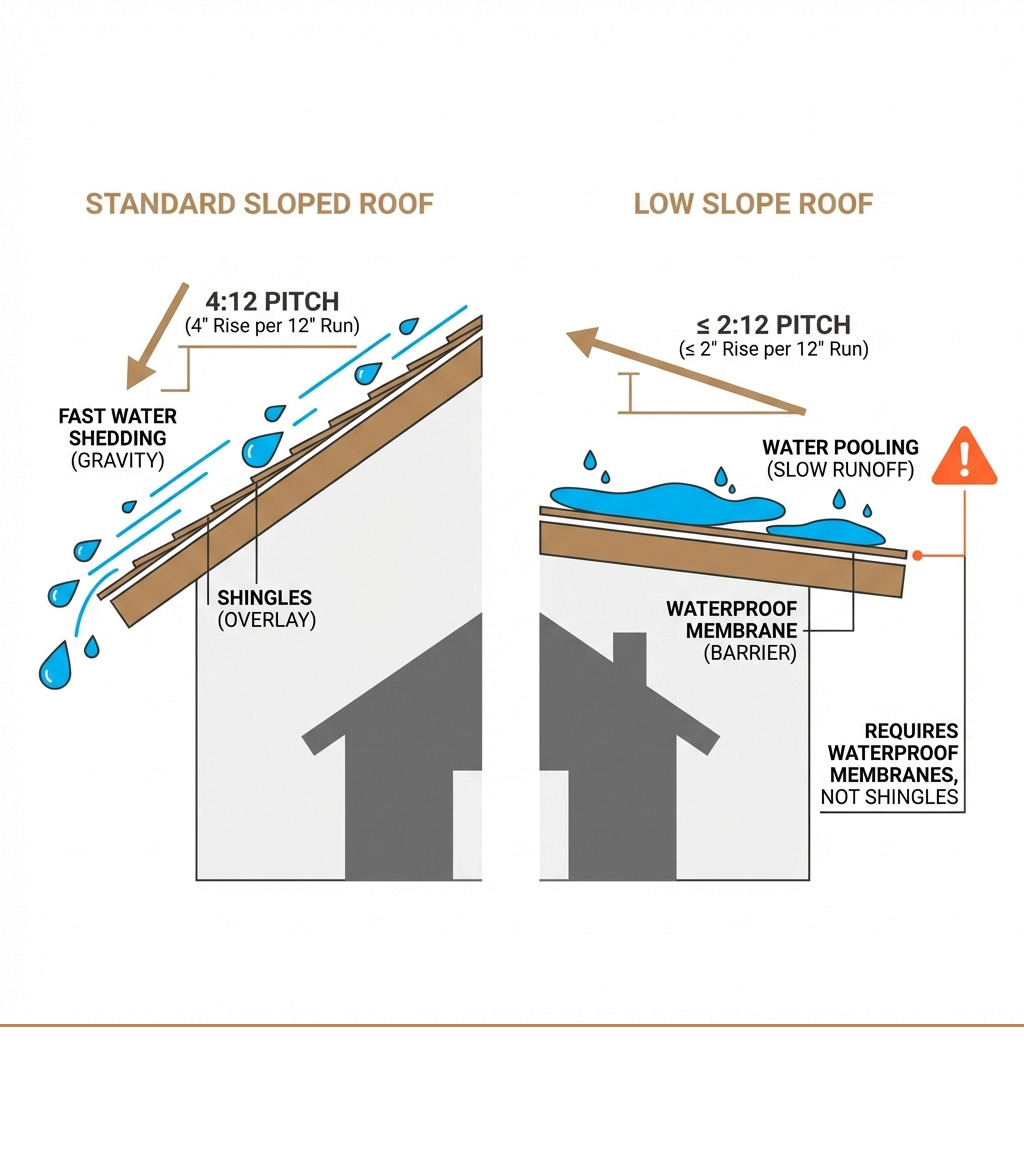
Low slope roof repair is essential for protecting your Utah property from water damage, structural issues, and costly replacements. Unlike steep roofs that shed water quickly, low slope roofs (those with a pitch less than 2:12) rely on waterproof membranes rather than gravity alone to keep water out.
Quick Answer: Key Steps for Low Slope Roof Repair
- Identify the problem – Look for ponding water, membrane cracks, blisters, or damaged flashing
- Clean and prepare – Remove debris and ensure the repair area is dry
- Apply the fix – Patch punctures, seal cracks, or replace damaged sections using compatible materials
- Address drainage – Clear drains, install tapered insulation, or build up low spots to prevent water pooling
- Consider professional help – For repairs larger than 10 square feet or persistent leaks
Low slope roofs face unique challenges that steep roofs don’t. Water can pool on the surface for days after a storm, slowly working its way through seams and weak spots. The 2018 International Residential Code even prohibits installing standard asphalt shingles on roofs below a 2:12 pitch because they simply can’t handle standing water.
The good news? Most low slope roof problems are fixable when caught early. A small membrane tear that costs $500 to patch today could become a $5,000+ structural issue tomorrow if water seeps into your insulation or decking.
Whether you’re dealing with a commercial flat roof or a residential low slope section, understanding what to look for and when to act can save you thousands in repair costs. This guide walks you through spotting problems early, choosing the right repair approach, and knowing when professional help is worth the investment.
Introduction: Understanding Your Low Slope Roof
When we talk about roofs, most people visualize a classic A-frame with a steep incline. However, many homes and commercial buildings across Salt Lake City and the Wasatch Front feature low slope roofs, which are fundamentally different in their design and maintenance needs.
A roof’s “pitch” defines its steepness. It’s calculated by measuring the number of inches or feet it rises vertically for every 12 inches or feet it extends horizontally. For example, a 4/12 pitch means the roof rises 4 inches for every 12 inches of horizontal run. A roof is officially considered “low slope” when its pitch is below a 2:12, meaning it rises less than 2 vertical units for every 12 horizontal units.
This subtle difference in pitch has massive implications for how a roof handles water. Steep roofs are designed for water “shedding”—gravity quickly pulls water off the surface. Low slope roofs, on the other hand, rely on “waterproofing” systems. These systems are designed to prevent water from penetrating the roof membrane, even when it ponds or stands for extended periods.
This is precisely why traditional asphalt shingles are unsuitable for low slope roofs. Shingles are designed to shed water over lapped layers, but they are not watertight. If water ponds on them, it can easily seep underneath, leading to leaks, rot, and extensive damage. In fact, the 2018 International Residential Code prohibits their installation on roofs with a 2:12 pitch or less, and manufacturers will void warranties if this rule is ignored.
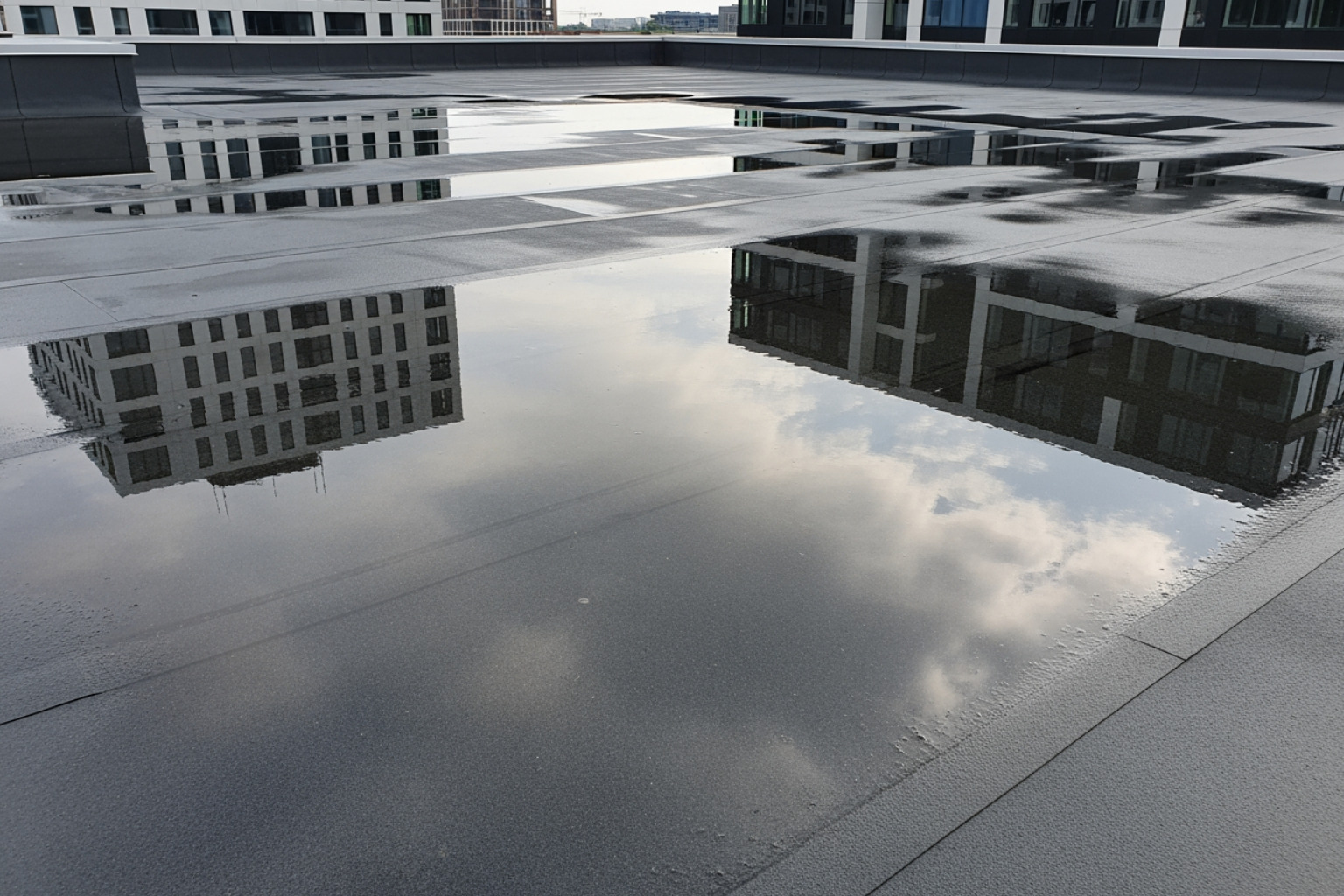
The primary challenge with low slope roofs is ponding water. Without a sufficient slope to drain water away, it can accumulate, putting extra stress on the roofing materials and increasing the likelihood of leaks. Our goal at Heaton Bros. Roofing is to help you understand these unique aspects so we can protect your property from the elements.
Spotting Trouble: Signs Your Low Slope Roof Needs Attention
Being vigilant about the condition of your low slope roof is the first step in proactive maintenance. Many problems start small and are easily fixable, but if left unaddressed, they can escalate into costly structural damage. Here are the key signs we look for that indicate your low slope roof might need low slope roof repair:
- Interior Water Stains: This is often the most obvious and alarming sign. Water stains on ceilings or walls, especially after rain or snowmelt, indicate a breach in your roof’s waterproofing. Even small, discolored spots can signal a developing problem.
- Blisters and Bubbles: These are raised areas on the roof membrane, often caused by trapped moisture or air underneath. While some small blisters might not leak immediately, they are weak points that can rupture under stress, leading to larger tears and water intrusion.
- Cracks and Tears in Membrane: Visible cracks, splits, or tears in the roofing material are direct pathways for water. These can be caused by UV degradation, thermal expansion and contraction, foot traffic, or impact damage.
- Damaged Flashing: Flashing is the material used to seal the edges of the roof and around penetrations like vents, skylights, and chimneys. If flashing is cracked, pulled away, or improperly installed, it’s a prime entry point for water.
- Clogged Drains or Scuppers: Low slope roofs rely heavily on their drainage systems. If drains, scuppers (openings in parapet walls), or gutters are clogged with debris, water will accumulate, leading to ponding and increased hydrostatic pressure on the roof membrane.
- Missing Gravel on BUR Roofs: For built-up roofing (BUR) systems, the gravel layer protects the underlying asphalt from UV radiation and physical damage. “Bald spots” where gravel is missing expose the asphalt, accelerating its degradation and making it brittle.
- Sagging Roof Deck: A sagging roof deck indicates a serious structural issue, likely caused by prolonged water saturation of the decking and insulation. This requires immediate professional attention as it compromises the entire integrity of the roof and building.
Key Signs You Need Low Slope Roof Repair
To summarize, we always advise our clients to look out for these critical indicators that signal the need for low slope roof repair:
- Visible Membrane Damage: Any crack, tear, puncture, or separation in the membrane material.
- Persistent Leaks After Rain: If you notice drips or stains every time it rains or snow melts, the problem isn’t going away on its own.
- Water Pooling for Over 48 Hours: While some ponding is inevitable on low slope roofs, water that remains for more than 48 hours indicates a drainage problem that needs to be addressed. This prolonged standing water significantly reduces the lifespan of roofing materials.
- Increased Energy Bills: A compromised roof can lead to wet, ineffective insulation, causing your heating and cooling systems to work harder and increasing your utility costs.
- Bald Spots on Tar-and-Gravel Roofs: Missing gravel means your roof’s protective layer is gone, leaving it vulnerable to UV damage and rapid deterioration.
Common Low Slope Roof Repair Techniques
When it comes to low slope roof repair, the specific technique we use depends on the type of damage and the roofing material. However, some fundamental principles always apply to ensure a lasting and effective fix.
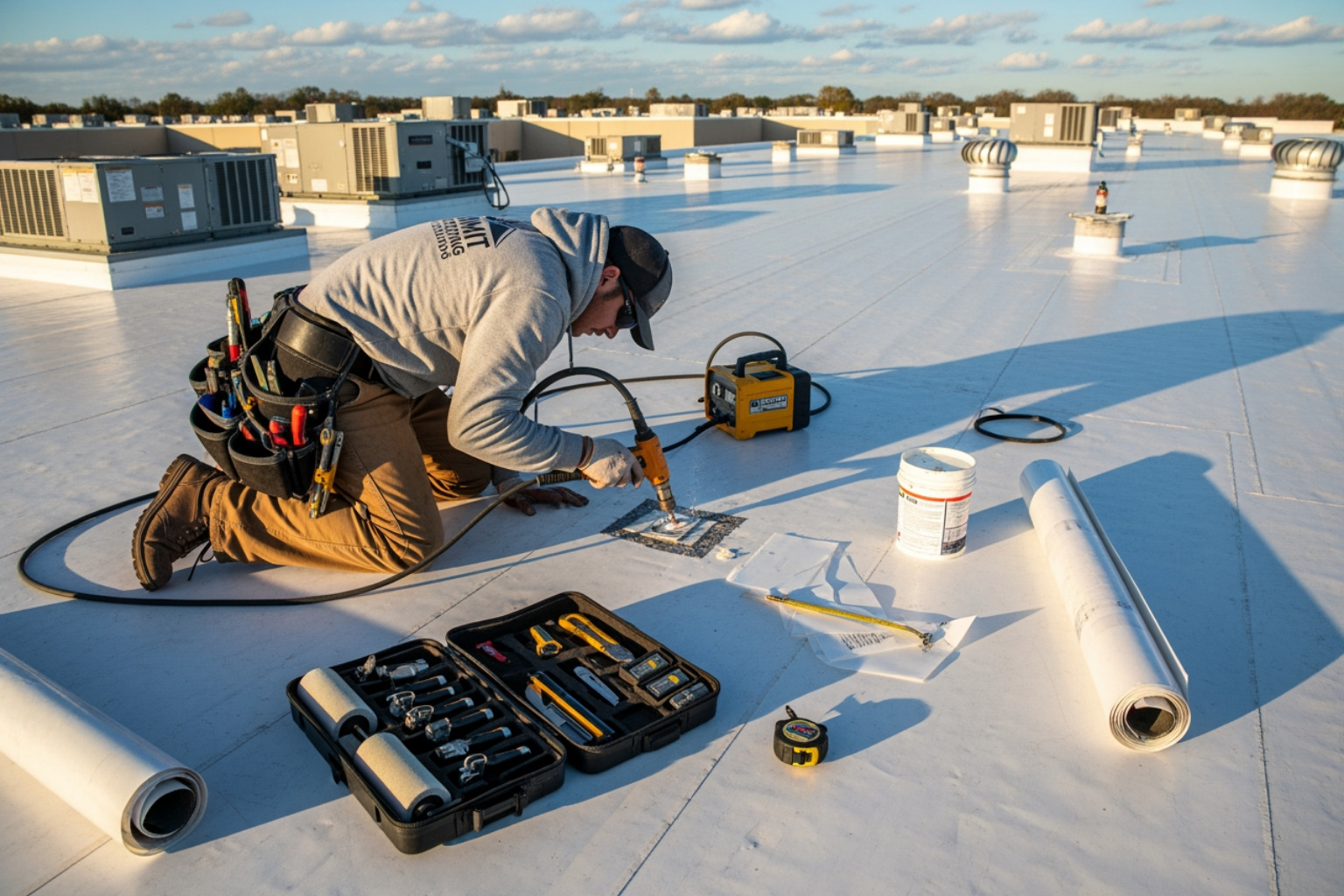
First and foremost, surface preparation is critical. The repair area must be sound, dry, smooth, and clean. This means removing all dirt, oil, grease, loose gravel, and any contaminants that could prevent proper adhesion. We emphasize safety precautions, especially when working on a roof. This includes using stable ladders, wearing non-slip shoes, and in some cases, safety harnesses. Finally, using compatible materials is paramount. An EPDM roof needs EPDM patches and adhesives, just as a modified bitumen roof requires asphaltic materials. Mixing incompatible materials can lead to premature failure of the repair.
Patching Cracks and Punctures in Membranes
Minor cracks, splits, or punctures are common issues on low slope roofs, especially single-ply membranes (TPO, EPDM, PVC). Here’s how we typically approach these repairs:
- Clean the Area: The repair area is thoroughly cleaned, often with specialized cleaners, and allowed to dry completely.
- Cut the Patch: We use a utility knife to cut a patch from compatible membrane material, ensuring it extends at least 2-3 inches beyond the damaged area in all directions. The corners of the patch are rounded to prevent future peeling.
- Apply Adhesive/Sealant: For EPDM, a specialized adhesive is applied to both the patch and the cleaned roof surface. For TPO and PVC, heat welding is often used to fuse the patch to the existing membrane, creating a seamless, watertight bond. For smaller cracks in asphalt-based systems, quality roofing cement or bitumen is applied.
- Reinforcing Fabric: For larger cracks or weaker areas, we may embed a reinforcing fabric (like fiberglass fabric or Pol-E-Force) into a layer of roofing cement for added strength before applying the final sealant or cap layer.
- Feathering Edges: We ensure the edges of the patch or sealant are smoothly feathered to prevent water from catching and to maintain a clean appearance.
Fixing Blisters and Delamination
Blisters and areas where the roof membrane has delaminated (separated from the substrate) are often caused by trapped moisture. Our approach is to release this moisture and re-adhere the membrane:
- Cut the Blister: We carefully cut open the blister in an X or T shape using a utility knife.
- Dry the Substrate: This is a crucial step. We ensure the area underneath the cut membrane is completely dry. This might involve using fans or allowing it to air dry for an extended period. If the underlying insulation or sheathing is wet, it may need to be dried out or even partially removed and replaced to prevent future issues.
- Apply Adhesive: Once dry, we apply compatible roofing adhesive or cement generously to the underside of the lifted membrane and the exposed substrate.
- Press Membrane Flat: The membrane is then pressed firmly back into place, expelling any trapped air. We may use a roller to ensure full contact.
- Seal the Cuts: The cuts are then sealed with a compatible sealant or a patch of membrane, ensuring a watertight repair.
Addressing Ponding Water Issues
Ponding water is a significant enemy of low slope roofs, accelerating material degradation and increasing leak potential. We tackle this in several ways:
- Clearing Drains and Scuppers: The simplest and often most effective first step is to ensure all existing drainage components are free of debris. Leaves, branches, and other foreign objects can quickly clog these critical pathways.
- Installing Tapered Insulation: For persistent ponding, we can install tapered insulation systems underneath the roof membrane. This insulation is designed with a slight slope (typically 1/4 inch per foot) to direct water towards drains, effectively creating positive drainage.
- Building Up Low Spots: In localized areas of ponding, we can build up low spots using additional layers of roofing material or specialized fill materials, again to create a slight incline for water runoff.
- Creating Positive Drainage: The goal is to achieve positive drainage, where water flows freely off the roof within 48 hours of rainfall. If the existing structure doesn’t allow for this, we may need to implement more comprehensive solutions like tapered insulation or structural modifications.
Repairing Damaged Flashing
Flashing is the unsung hero of a watertight roof. When it fails, leaks are almost guaranteed. Our process for repairing damaged flashing involves:
- Removing Old Flashing: Carefully removing the compromised flashing, taking care not to damage adjacent roofing materials or the underlying structure.
- Cleaning the Substrate: The area where the new flashing will be installed is thoroughly cleaned and prepared, ensuring a solid, dry surface for adhesion.
- Installing New Flashing (Metal or Membrane): We install new flashing, which can be made of various materials depending on the roof system—metal for parapet walls or vent pipes, or membrane material for transitions and edges. The new flashing must be properly integrated with the roof membrane.
- Sealing All Seams and Edges Properly: All laps, seams, and edges of the new flashing are carefully sealed with compatible adhesives or sealants to create a continuous, watertight barrier. This often involves embedding the flashing into roofing cement or heat-welding it to the membrane.
Materials & Systems: Choosing the Right Fix
Choosing the right materials is crucial for effective low slope roof repair. The choice often depends on the existing roof system, the extent of the damage, and your long-term goals. We consider whether a simple repair will suffice, if a re-cover (applying a new layer over the old) is appropriate, or if a full replacement is necessary. Material compatibility is paramount; what works for a TPO roof won’t work for a modified bitumen system.
Single-Ply Membranes (TPO, EPDM, PVC)
Single-ply membranes are popular for low slope roofs due to their flexibility, durability, and relatively easy installation compared to multi-layer systems. They come in large, flexible sheets that are either mechanically fastened, adhered, or ballasted.
- Thermoset vs. Thermoplastic: EPDM (ethylene propylene diene monomer) is a thermoset material, meaning its chemical structure is permanently set after curing, making it very stable. It’s often likened to a “bulletproof rubber roof” due to its durability. TPO (thermoplastic polyolefin) and PVC (polyvinyl chloride) are thermoplastics, meaning they can be softened by heating and re-hardened by cooling. This property allows for heat-welded seams, creating a monolithic, watertight bond.
- Heat-Welded Seams: For TPO and PVC, sections of the membrane are fused together using heat, forming incredibly strong and watertight seams. This is a significant advantage in waterproofing.
- Durability: All three offer excellent durability and weather resistance. EPDM is known for its long-term resistance to UV radiation and weathering. TPO and PVC offer similar benefits, with TPO being a common choice for its balance of performance and cost.
- Lifespan: EPDM roofing membrane can last around 25 to 30 years. PVC roofing membrane and TPO membrane can also last around 25 years when properly installed and maintained.
- Energy-Efficient Options: White TPO and PVC membranes are highly reflective, which can significantly reduce cooling costs in warmer climates like Utah by reflecting sunlight away from the building. This makes them excellent energy-efficient options.
Built-Up Roofing (BUR) and Modified Bitumen
These are traditional asphalt-based systems that have been used for decades.
- Built-Up Roofing (BUR): Often referred to as “tar and gravel” roofs, BUR systems are multi-layered. They consist of alternating layers of asphalt (bitumen) and reinforcing fabrics (felt), topped with a layer of gravel or mineral granules. This multi-layer approach provides exceptional waterproofing and durability. A properly maintained tar and gravel flat roof can last between 20 to 25 years, with some functioning well for 20 to 30 years. The gravel layer protects the underlying asphalt from UV radiation, adds weight for wind uplift resistance, and provides an additional layer of protection.
- Modified Bitumen: This is an evolution of BUR, using asphalt that has been modified with polymers (either APP plastic or SBS rubber) to improve its flexibility and durability, especially in extreme temperatures. Modified bitumen often comes in rolls and can be installed using torches (heat-welded), cold adhesives, or self-adhering methods. Its lifespan is generally comparable to BUR, often lasting 20-30 years with proper maintenance. Modified bitumen is noted as being one of the more cost-effective commercial flat roofing systems, though its lifespan can be shorter than single-ply if not regularly maintained.
[TABLE] Comparing Low Slope Roofing Materials
Here’s a quick comparison of common low slope roofing materials we work with across our service areas, from Salt Lake City to Ogden, and Provo to Tooele:
| Material Type | Average Lifespan | Key Advantages | Common Repair Methods |
|---|---|---|---|
| EPDM (Thermoset) | 25-30 years | Highly durable, UV resistant, flexible, “rubber roof” | Patches with adhesive, seam repairs with tape/sealant |
| TPO (Thermoplastic) | 25 years | Energy-efficient (white), heat-welded seams, durable | Heat-welded patches, seam repairs |
| PVC (Thermoplastic) | 25 years | Energy-efficient (white), heat-welded seams, chemical resistant | Heat-welded patches, seam repairs |
| Modified Bitumen | 20-30 years | Flexible, durable, multi-layer protection | Patches with asphalt cement/adhesive, torch-applied patches |
| Built-Up Roofing (BUR) | 20-30 years | Excellent waterproofing, heavy-duty, fire resistant | Asphalt cement, gravel replacement, layered patches |
DIY vs. Professional Repair: Cost & Considerations
When faced with a low slope roof issue, many homeowners and business owners in Utah might wonder: “Can I fix this myself, or do I need to call a professional?” It’s a valid question, and the answer depends heavily on the nature and extent of the damage, as well as your own expertise and comfort level.
Attempting a low slope roof repair yourself carries inherent safety risks. Working on a roof, especially a low slope one where drainage can be an issue, requires proper ladder safety, fall protection, and awareness of weather conditions. Furthermore, effective repairs often require specialized tools and materials that aren’t readily available at your local hardware store. Most importantly, professional repairs come with warranties, protecting your investment, and ensure compliance with local building codes, like those referenced in the 2018 International Residential Code.
When to DIY
For the handy homeowner, there are a few minor low slope roof maintenance tasks and repairs that you might be able to handle:
- Minor Crack Sealing: If you identify a very small, superficial crack (less than a few inches) in an accessible area, and you have the correct, compatible sealant, you might be able to apply a temporary fix. This is often a stop-gap measure until a professional can assess it.
- Small Patch Application (<1 sq ft): For tiny punctures or very localized damage, a small, pre-made patch kit compatible with your roof’s membrane might offer a temporary solution. Always follow manufacturer instructions carefully.
- Clearing Debris from Drains: Regularly cleaning leaves, branches, and other debris from roof drains, scuppers, and gutters is crucial preventative maintenance that you can (and should) do yourself. This prevents ponding water, which is a major cause of low slope roof problems.
However, we always caution that even small DIY repairs can turn into bigger problems if not done correctly. The unique challenges of low slope roofing, such as ensuring proper adhesion and preventing water intrusion, often require professional expertise.
When to Call a Professional
For anything beyond the most basic maintenance, we strongly recommend calling a professional like Heaton Bros. Roofing. Here’s why and when:
- Large Damaged Areas (>10 sq ft): Extensive damage requires significant material and expertise to repair properly. For example, if you find wet insulation or sheathing, that’s a job for a professional.
- Persistent Leaks: If a leak keeps coming back despite your best efforts, it indicates a deeper, more complex issue that requires expert diagnosis and repair.
- Structural Sagging: Any visible sagging of the roof deck is an immediate red flag. This points to potential structural damage, likely due to prolonged water infiltration, and needs urgent assessment by a qualified professional.
- Flashing Replacement: Flashing around vents, skylights, chimneys, and parapet walls is critical for waterproofing. Replacing or repairing it correctly requires specialized skills and materials to ensure a watertight seal. This is not a DIY task.
- Complex Systems: If your roof is a modified bitumen, TPO, EPDM, or BUR system, repairs often involve specialized techniques like heat welding or multi-layer applications that are best left to experienced roofers.
- NRCA Guidelines: The Repair Manual for Low-slope Membrane Roof Systems, 2nd Edition from the NRCA (National Roofing Contractors Association) emphasizes the complexity of these repairs, underscoring the need for professional knowledge. Furthermore, the NRCA outlines “replacement triggers” such as wet insulation, perimeter conditions preventing proper flashing height, or a damaged roof deck, all of which necessitate professional intervention and potentially full replacement rather than just a repair.
Cost of Low Slope Roof Repair vs. Replacement
Understanding the financial implications is a major factor in deciding on low slope roof repair or replacement.
- Minor Repair Costs: For small, localized issues like patching minor cracks or sealing small penetrations, you can expect costs to range from $300 to $2,000. These are typically quick fixes that extend the life of your roof.
- Extensive Repair Costs: When there’s widespread damage, multiple leaks, or issues with underlying components like insulation, repair costs can quickly escalate, potentially exceeding $5,000. At this point, we often discuss whether a full replacement might be a more cost-effective long-term solution.
- Labor Costs: The average cost for professional flat roofing labor in Utah ranges between $50 and $100 per hour. The total cost will depend on the complexity and duration of the repair.
- Replacement as a Long-Term Investment: While a full roof replacement is a larger upfront investment, it often provides peace of mind, a significantly longer lifespan, and improved energy efficiency. For example, replacing an old, failing roof with a new EPDM or TPO system can give you 25-30 years of reliable protection. Sometimes, what seems like an expensive replacement today can save you from a series of costly, recurring repairs tomorrow.
Conclusion: Protecting Your Home with Proactive Care
Protecting your property in Salt Lake City, and across the Wasatch Front, whether it’s in Alpine, Bountiful, or West Jordan, starts with a healthy roof. For low slope roofs, this means proactive care and timely intervention. Regular inspections are your first line of defense, helping us identify and address minor issues like clogged drains or small membrane imperfections before they escalate into major problems.
The importance of timely repairs cannot be overstated. A small crack today can lead to water intrusion, wet insulation, and structural damage tomorrow, turning a minor low slope roof repair into a complete roof replacement. By addressing these issues promptly, we can significantly extend your roof’s lifespan, saving you considerable stress and expense in the long run.
At Heaton Bros. Roofing, we’re a 4th-generation, family-owned roofing company with over 65 years of experience serving Utah. We understand the unique challenges that low slope roofs face in our climate, from heavy snow loads to intense summer sun. Our reliability and commitment to customer satisfaction mean you can trust us to provide quality, affordable solutions, whether it’s a minor repair or a complete replacement.
Don’t wait for a small leak to become a big headache. For expert advice and professional service for all your low slope roofing needs, we’re here to help. Get a professional assessment for your roof repairs today and let us help you protect your home or business for years to come.