
How Long Does a Small Commercial Roof Installation Actually Take?
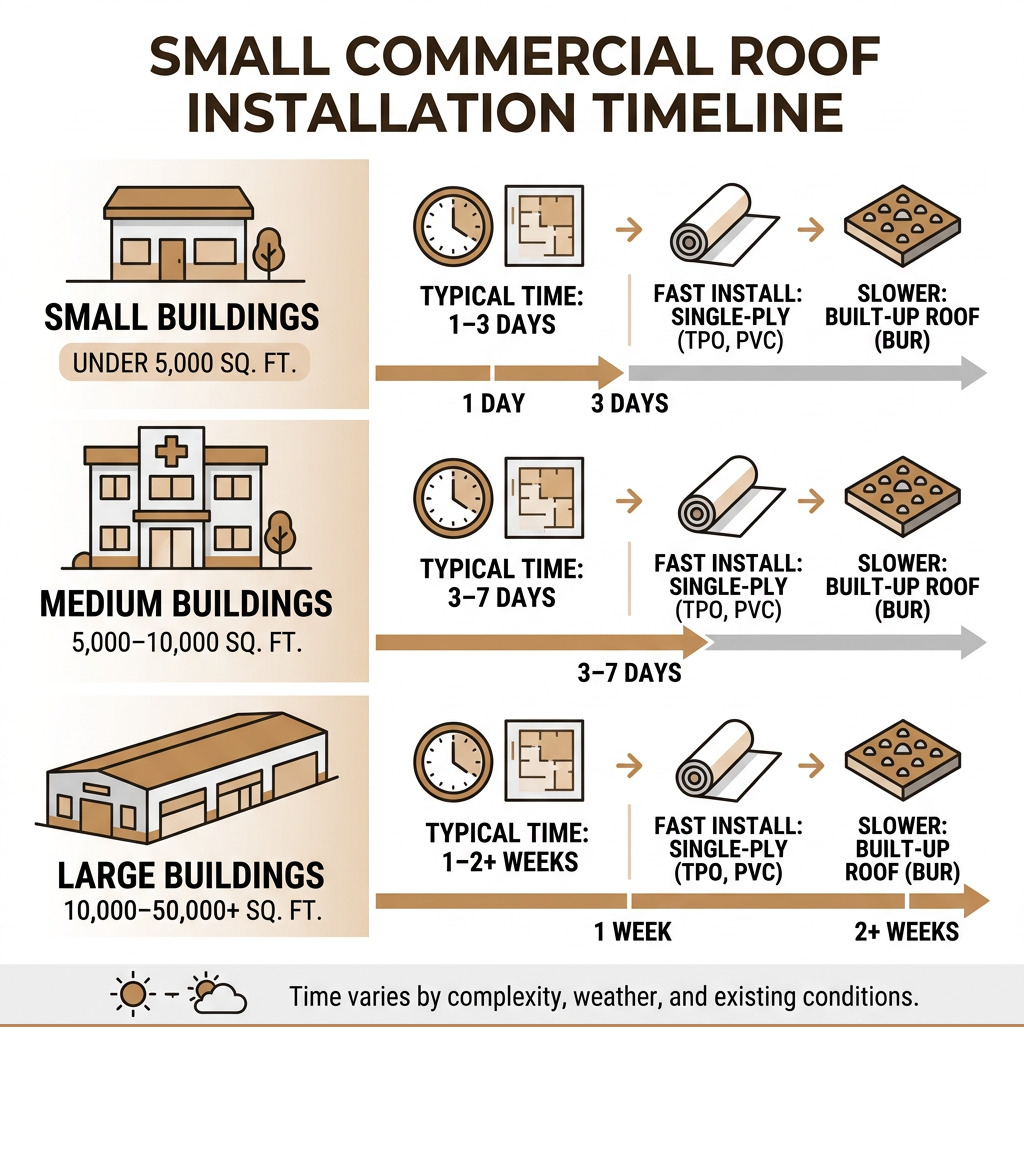
The average installation time small commercial roof falls between 3 and 7 days for most buildings in the 5,000–10,000 square foot range — assuming no major structural surprises and reasonable weather.
Here’s a quick reference so you can plan around your business:
| Building Size | Typical Installation Time |
|---|---|
| Under 5,000 sq. ft. | 1–3 days |
| 5,000–10,000 sq. ft. | 3–7 days |
| 10,000–50,000 sq. ft. | 1–2 weeks |
| 50,000+ sq. ft. | 2–4 weeks or more |
These ranges reflect real-world conditions — not best-case scenarios. Material type, weather, permits, and roof complexity all push that number up or down.
If you own or manage a small commercial property, the roof timeline question isn’t just academic. Every extra day of installation is a day your business operates under scaffolding, noise, and restricted access. Getting a realistic estimate upfront helps you plan staffing, notify customers, and avoid nasty surprises.
This guide breaks down exactly what drives that 3–7 day window — and what can shrink it or blow it wide open.
Defining the Small Commercial Roof and Its Timeline
When we talk about small commercial roofing, we generally refer to buildings between 5,000 and 10,000 square feet. Think of your local strip mall, a standalone medical clinic, or a small warehouse in Salt Lake City. These structures are unique because they sit right in the “sweet spot” of roofing—larger than a house, but not so massive that they require a month-long logistical operation.
In our category commercial roofing experience, the square footage is the primary driver of the clock, but it isn’t the only one. A 6,000-square-foot flat roof with no obstructions can often be finished faster than a 3,000-square-foot roof packed with HVAC units and skylights.
What is the average installation time small commercial roof?
For most projects in the Wasatch Front, the average installation time small commercial roof is 3 to 7 days. This timeframe covers the full lifecycle of the project, from the moment the first shingle or membrane layer is peeled back to the final site cleanup.
Industry benchmarks suggest that a highly efficient crew can cover roughly 6,000 square feet of “open” roofing (flat areas with no obstacles) per day. However, once you add in “complex” areas—chimneys, vents, and equipment curbs—that speed can drop to about 2,000 square feet per day. This is why a “small” roof can still take a full week if it has a complicated layout.
Material Selection and the average installation time small commercial roof
The “what” matters just as much as the “how much.” Different materials require different installation techniques, which directly impacts the average installation time small commercial roof.
- TPO (Thermoplastic Polyolefin): This is the “speed demon” of commercial roofing. Because it comes in large rolls and is heat-welded at the seams, a TPO system can often be installed in 3–5 days.
- EPDM (Ethylene Propylene Diene Terpolymer): Often called “rubber roofing,” EPDM is also quite fast, typically taking 4–6 days. It’s often adhered or mechanically fastened, which moves quickly on flat surfaces.
- PVC Systems: Similar to TPO but often used for restaurants due to grease resistance, PVC usually takes 3–5 days.
- Metal Roofing: While incredibly durable, metal is labor-intensive. Expect a timeline of 1–2 weeks for a small commercial building, as each panel must be precisely fitted and fastened.
- Asphalt Shingles: For sloped commercial buildings, shingles are a familiar and fast option. Thanks to Owens Corning material efficiency, many smaller shingle projects can be completed in as little as 1–3 days.
Factors Affecting the Average Installation Time Small Commercial Roof
If every roof were a flat, empty rectangle, we could give you a quote down to the minute. But real-world buildings have “character.” When understanding the roof installation process what to expect, you have to account for the obstacles.
Roof Complexity and Penetrations The more “stuff” sticking out of your roof, the longer the job takes. HVAC units, exhaust fans, pipes, and skylights all require specialized flashing. Each penetration must be meticulously sealed to prevent leaks. If your roof looks like a forest of vents, add at least 1–2 days to your timeline.
Staging and Accessibility Can we park our trucks right next to the building? Is there a clear spot for a crane? If the building is in a cramped downtown Salt Lake City alley, moving materials to the rooftop takes longer. Accessibility issues can easily add a day to the project just in logistics.
Safety Protocols We never cut corners on safety. Following OSHA safety protocols—such as setting up perimeter warning lines, fall-arrest systems, and safety monitors—takes time at the start of each day. While it might add a few hours to the total project, it ensures the job is done right and without legal or physical incidents.
External Variables: Weather, Permits, and Labor
Sometimes the delays come from things we can’t control.
- Weather: According to NOAA weather data, the Wasatch Front can be unpredictable. Rain, snow, and high winds are the ultimate “wild cards.” You cannot install a TPO membrane on a wet deck, and high winds make handling large sheets of material dangerous. A single day of heavy rain can push a project back by two days—one for the storm and one for the roof to dry out.
- Permits and Inspections: Before we tear off a single shingle, we need a green light. Dealing with City permits and inspections (or your local municipality in Utah) can take anywhere from a few days to a few weeks depending on their backlog. Furthermore, most commercial jobs require a mid-point or final inspection from a city official, and we are often at the mercy of their schedule.
- Labor and Supply Chain: The BLS labor shortage statistics highlight a nationwide challenge in finding skilled tradespeople. While we maintain a consistent, expert crew, the broader industry sometimes struggles with material lead times. If a specific color of metal or a certain type of insulation is backordered, the project start date might shift, even if the actual installation time remains the same.
Step-by-Step: The Small Commercial Roofing Process

To give you a better idea of how that average installation time small commercial roof is spent, let’s look at the typical “Day 1 to Day 7” workflow.
- Initial Inspection & Staging (Day 1): We arrive, set up safety barriers, and stage the materials. This is when we confirm the findings from what to expect from a roofing estimate.
- Tear-Off and Removal (Day 1–2): If it’s a replacement, the old material has to go. This is often the loudest and messiest part of the job.
- Decking Repair & Preparation (Day 2–3): Once the old roof is off, we inspect the “deck” (the wood or metal structure underneath). If we find rot or damage, we fix it here. This is vital for the long-term health of your building.
- Insulation & Underlayment (Day 3–4): We lay down the thermal barrier and the base layers that provide the first line of defense against the elements.
- Membrane/Material Application (Day 4–6): The main event. This is when the TPO, EPDM, or shingles are installed.
- Flashing and Detailing (Day 6–7): We seal the edges, vents, and HVAC curbs. This is the precision work that prevents future leaks.
- Final Inspection & Cleanup (Day 7): We do a final walk-through and ensure your property is cleaner than when we arrived.
Minimizing Disruptions During Installation
We know your business doesn’t stop just because your roof needs work. To keep your operations running smoothly, we focus on:
- Off-Peak Scheduling: Whenever possible, we try to handle the loudest tasks (like tear-offs) during your least busy hours.
- Safety Zones: We clearly mark areas for customers and employees to avoid, ensuring everyone stays safe without blocking your main entrance.
- Optimal Crew Size: By finding your perfect match commercial roofing in salt lake city, you ensure the team is big enough to be fast, but not so big that they create a logistical nightmare in your parking lot.
Frequently Asked Questions about Commercial Roof Timelines
Is a roof replacement slower than a new installation?
Yes, typically. A new installation starts with a clean slate (the deck is already there and ready). A replacement requires a “tear-off” phase, which can add 1–3 extra days. Additionally, replacements often reveal hidden structural issues in the decking that require repair before the new roof can go on.
How does crew size affect the speed of installation?
There is a “Goldilocks” zone for crew size. For a small commercial roof, a team of 10–20 people is often ideal. If the crew is too small, the job drags on. If it’s too large, workers start getting in each other’s way, which can actually decrease efficiency and compromise safety. We use specialized technicians for different tasks (like one team for the membrane and another for the metal flashing) to keep the line moving.
Can a small commercial roof be finished in one day?
It’s rare, but possible! If the roof is under 2,500 square feet, uses a simple asphalt shingle system, and requires no structural repairs, a large, experienced crew can sometimes knock it out in a single day. However, for most “standard” small commercial buildings, 3 days is a more realistic minimum to ensure quality isn’t sacrificed for speed.
Conclusion
At Heaton Bros. Roofing, we’ve spent four generations perfecting the art of the efficient roof. We know that for business owners in Salt Lake City, Draper, and across the Wasatch Front, time is money. Our goal is always to provide a high-quality, durable roof while keeping the average installation time small commercial roof as short as possible.
Whether you are in Lehi or Logan, Bountiful or Bluffdale, proper planning is the key to a stress-free project. If you’re ready to get started, check out the ultimate guide to roof installation in salt lake city or head over to our small-commercial-roofing page to see how we can help your business stay covered.
With over 65 years of experience, we don’t just watch the clock—we make every minute count. Reach out to us today for a reliable estimate and a timeline you can actually set your watch to.