

Why Built Up Roof Repair Is Critical for Your Commercial Property
Built up roof repair is the process of restoring the multiple waterproofing layers of a flat or low-slope roofing system — and getting it right can be the difference between a minor maintenance cost and a major structural headache.
Here’s a quick breakdown of what most building owners need to know:
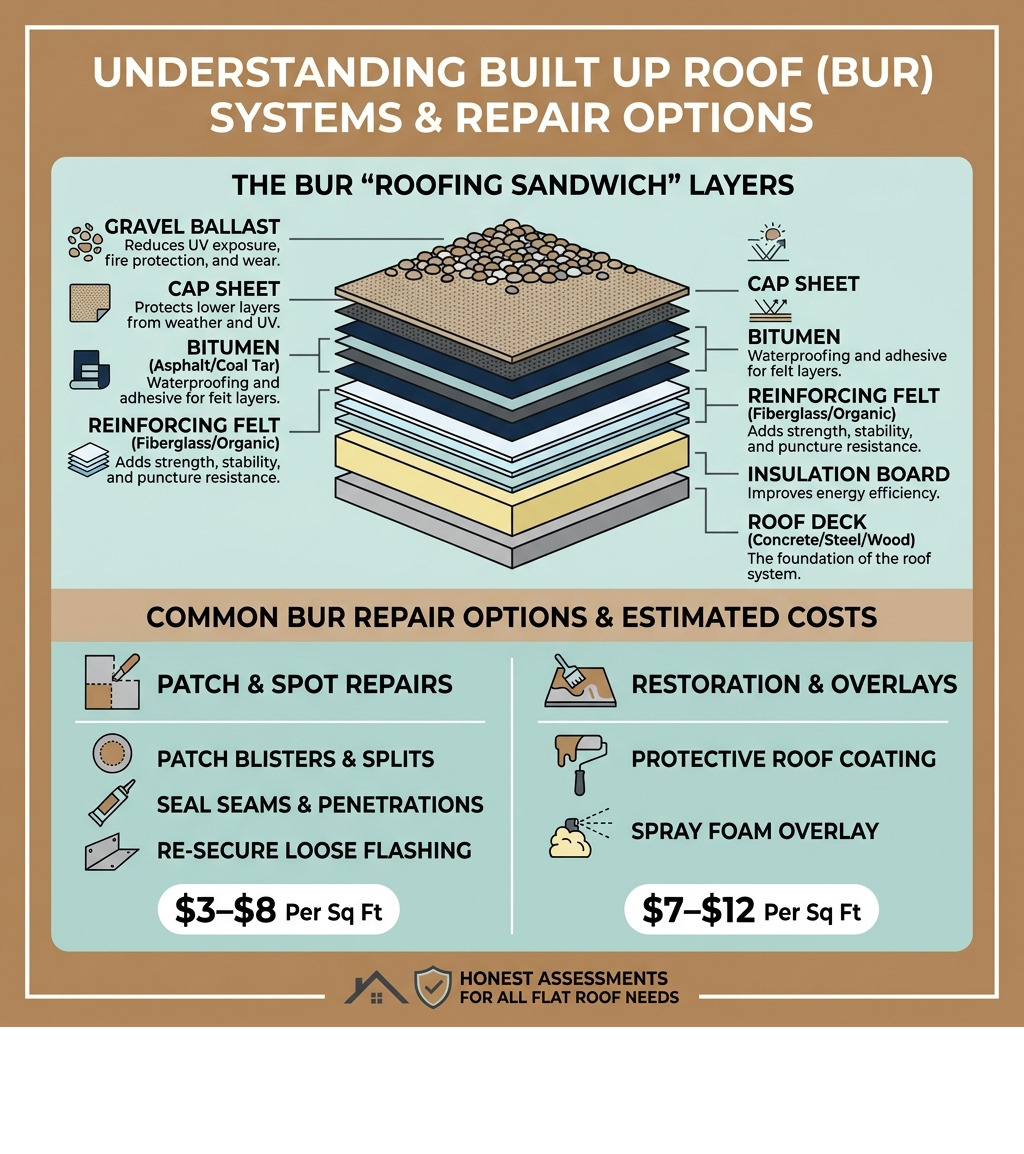
- What it is: BUR systems use alternating layers of bitumen and reinforcing felt, topped with gravel or a cap sheet. Repairing them means restoring one or more of those layers.
- Common repairs: Patching blisters or splits, replacing failed flashing, resealing seams, applying protective coatings, or installing a spray foam overlay.
- When to repair vs. replace: Repair if damage is localized and the deck is sound. Consider replacement if the roof is 20–30+ years old or has widespread moisture damage.
- Typical costs: Patch repairs run roughly $3–$8 per sq ft. Full overlays can reach $7–$12 per sq ft.
- Best next step: Get a professional inspection to assess moisture intrusion and structural integrity before choosing a repair method.
A BUR system is built like a sandwich — layer after layer of protection stacked on top of each other. That redundancy is its biggest strength. But when one layer fails, water finds a way in fast, and the damage often spreads silently beneath the surface before you notice a single stain on your ceiling.
Utah’s climate makes this worse. Freeze-thaw cycles, intense summer UV, and heavy snow loads all accelerate wear on flat roofs. Ignoring early warning signs rarely saves money — it almost always costs more later.
At Heaton Bros. Roofing, we’ve handled built up roof repair and full roof restoration for homeowners and business owners throughout the Salt Lake City area, bringing hands-on craftsmanship and honest assessments to every job. If you’re seeing signs of wear on your flat roof, we’re here to help you figure out the smartest path forward.
Understanding the Built-Up Roof (BUR) System
To understand how to fix a roof, you first have to understand how it’s built. A Built-Up Roof (BUR) is one of the oldest and most reliable commercial roofing technologies in the United States, with roots stretching back to the 1840s. It’s often called a “tar and gravel” roof, though modern versions have evolved significantly from the early days of coal tar.
The system is defined by its multi-ply construction. Instead of a single sheet of rubber or plastic, a BUR consists of alternating layers of bitumen (asphalt or coal tar) and reinforcing felts (fabrics). This creates a thick, monolithic membrane that is incredibly difficult for water to penetrate. In our experience providing Expert Roof Repair Services, we’ve seen these systems last anywhere from 15 to 40 years, depending on how well they were maintained and the local weather conditions along the Wasatch Front.
The Evolution of BUR Technology
While the basic concept remains the same, the materials have gotten a major upgrade. Traditionally, BUR was installed using “hot mopping,” where asphalt was heated in a kettle to around 400°F (204°C) and spread across the roof. While this is still common, we now see more cold-applied adhesives. These use low-fuming solvent-based asphalts, which eliminate the odors and fire hazards associated with hot kettles—a big plus for occupied buildings in Salt Lake City.
Reinforcing plies have also moved from organic paper-based felts to high-strength fiberglass. These fiberglass plies don’t rot and provide much better dimensional stability. Finally, the top layer—the surfacing—can range from traditional gravel to mineral-surfaced cap sheets or even highly reflective “cool roof” coatings that help lower building temperatures during our scorching Utah summers.
Why Redundancy Matters for Commercial Properties
The “sandwich” design isn’t just for show. The primary benefit of a BUR system is redundancy. If the top layer of a single-ply roof is punctured, you have a leak. If the top layer of a BUR system is damaged, you still have several other waterproof plies underneath acting as a backup.
This layered approach provides:
- Superior Waterproofing: Multiple barriers make it highly resistant to leaks.
- Fire Resistance: BUR systems often meet the highest fire ratings (UL Class A) because the gravel or mineral surfacing acts as a natural fire retardant.
- Uplift Resistance: Because the layers are bonded together into a heavy, solid mass, they perform exceptionally well against the high winds we see in places like Eagle Mountain and Draper.
- Durability: The thick membrane can withstand foot traffic from HVAC technicians better than thinner alternatives.
For more details on how these systems compare to other low-slope options, check out our guide to low slope roof maintenance.
Identifying Common Issues Requiring Built Up Roof Repair
Even the toughest roofs eventually show their age. Because BUR systems are so thick, they don’t always “fail” all at once. Instead, they develop specific symptoms that indicate it’s time for a professional built up roof repair.
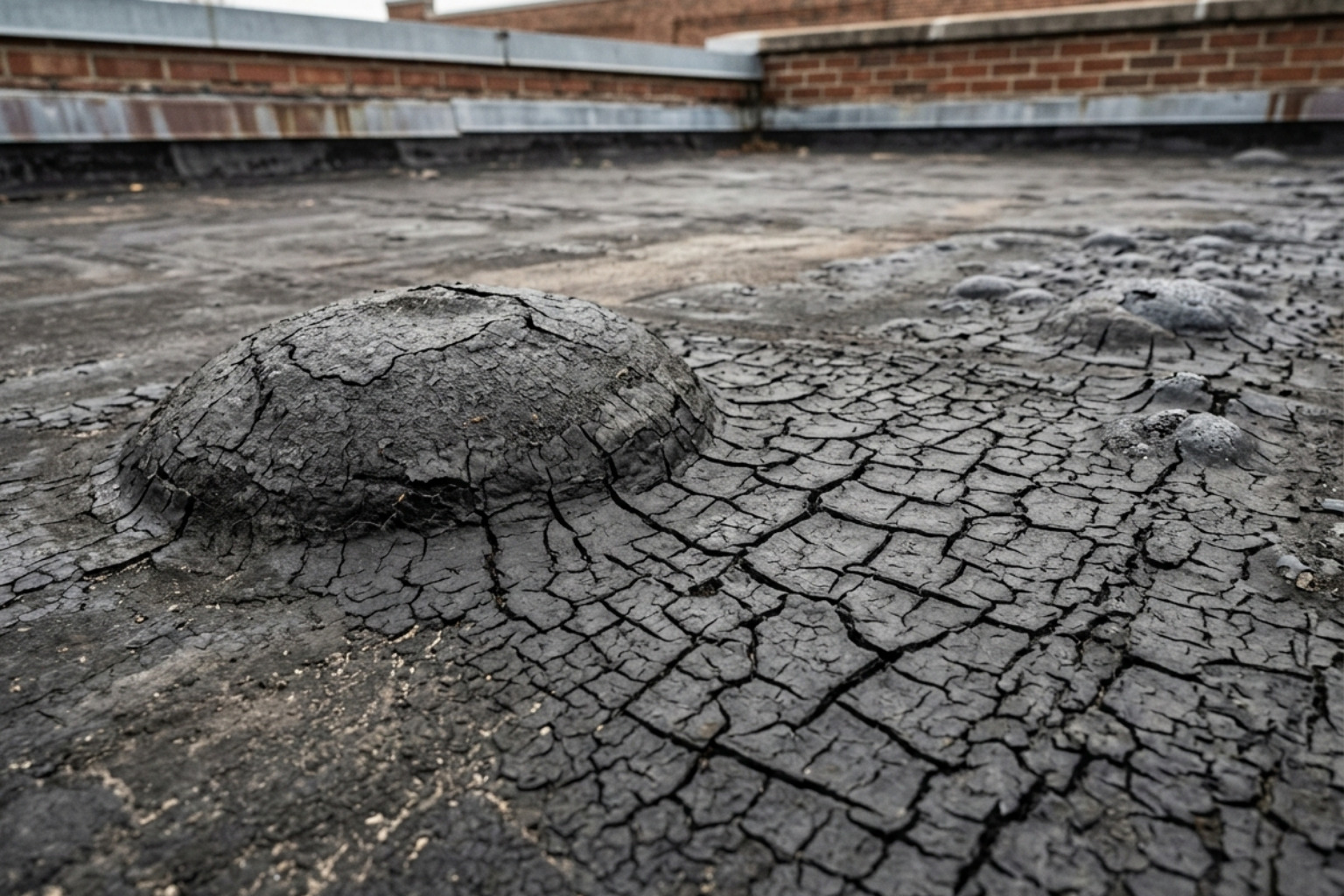
One of the most common sights is “alligatoring.” This is when the top layer of bitumen oxidizes and cracks, creating a pattern that looks like an alligator’s hide. While it looks bad, it’s often a sign that the sun has dried out the oils in the asphalt. Other issues include:
- Blisters: These look like bubbles on the roof surface. They are caused by air or moisture trapped between the felt layers. As the sun heats the roof, the pocket expands.
- Ponding Water: If water sits on your roof for more than 48 hours after a storm, you have a drainage issue. This standing water puts immense pressure on the seams and can lead to rapid degradation.
- Gravel Migration: On gravel-surfaced roofs, wind or water can push the rocks away, leaving “bare spots.” These spots are vulnerable to UV damage.
- Flashing Failure: The metal or membrane bits around vents, chimneys, and parapet walls are the most common leak points.
For a technical deep dive into these defects, the Canadian Roofing Reference Manual offers excellent standardized troubleshooting protocols.
Signs Your Commercial Roof Needs Immediate Attention
You don’t always have to climb a ladder to know there’s a problem. If you see interior stains on your ceiling tiles, mold growth in the attic, or a sudden spike in your energy bills, your roof is likely compromised. In Utah, we also look for “granule loss”—if you see piles of small black rocks in your downspouts, your cap sheet is losing its protective layer.
In communities like Provo, where many older commercial buildings still use BUR, we emphasize that Provo Flat Roof Repair Is A Top Priority because the heavy snow loads in the valley can turn a small crack into a structural collapse overnight.
Repair vs. Replacement: Making the Cost-Effective Choice
As a 4th-generation family business, we always try to save our customers money by repairing when possible. However, there comes a point where patching a roof is like putting a band-aid on a broken leg.
| Factor | Favor Repair | Favor Replacement |
|---|---|---|
| Roof Age | Under 15-20 years | Over 25-30 years |
| Leak Scope | Localized to one area | Multiple leaks in different spots |
| Insulation | Dry and intact | Saturated or “mushy” |
| Surface | Mostly intact | Widespread alligatoring/cracking |
| Cost | Less than 25% of replacement | More than 30-50% of replacement |
If your insulation is wet, the roof must be replaced (or at least the wet sections removed). Trapping moisture under a new repair will just lead to more blisters and rot. To learn more about choosing the right path, read our article on Protecting Your Home With The Right Roof Repair.
Step-by-Step Methods for Built Up Roof Repair
When we arrive for a built up roof repair, the process is methodical. You can’t just slap some tar on a leak and call it a day; the multi-layer nature of the roof requires a multi-layer fix.
- Surface Preparation: We start by clearing away all gravel, dirt, and debris. The area must be “clean enough to eat off of” (as the old saying goes) to ensure the new materials bond correctly.
- Drying: We use heat guns or air blowers to ensure no moisture is trapped in the repair area.
- Priming: An asphalt primer is applied to the cleaned surface to improve adhesion.
- Patching: We use a “five-course” method for permanent patches. This involves alternating layers of roofing cement (mastic) and reinforcing fabric (mesh), extending each layer a few inches beyond the last.
- Surfacing: Once the patch is set, we re-apply gravel or a protective coating to match the rest of the roof.
We provide these detailed roof repairs for all types of commercial and residential low-slope structures.
Fixing Blisters and Splits in the Membrane
Blisters are tricky. If a blister is small and not leaking, it’s sometimes best to leave it alone. However, if it’s in a high-traffic area or has cracked, we perform a “T-cut.” We slice the blister open in a cross shape, dry out the inside, and then fold the flaps back down with fresh adhesive before applying a reinforced patch over the top.
Splits—long cracks caused by the building shifting or the roof shrinking—require a “slip sheet.” We install a layer that allows for a bit of movement so the new patch doesn’t just crack again the next time the temperature drops in Park City. This attention to detail is How A Local Roofer Ensures Long Lasting Results.
Restoring Flashing and Drainage Systems
Most leaks don’t happen in the middle of the roof; they happen at the edges. We frequently replace old, rusted termination bars and reseal “pitch pockets” (the metal boxes around roof penetrations).
In areas with heavy rainfall, we might recommend upgrading to siphonic drains, which pull water off the roof faster than standard gravity drains. Ensuring your scuppers are clear and your drainage is sloped correctly is what makes us The Best Flat Roof Repair Specialists In Utah.
Modern Alternatives: Coatings and Spray Foam Overlays
If your BUR system is aging but the structure is still sound, you might not need a full tear-off. Modern restoration techniques can add 10 to 20 years to your roof’s life at a fraction of the cost of replacement.
Benefits of Silicone and Acrylic Coatings
Silicone coatings are a game-changer for built up roof repair. Unlike older paints, silicone is “moisture-cured” and can handle ponding water without breaking down.
- UV Reflectivity: They reflect up to 85% of sunlight, significantly lowering cooling costs.
- Seamless: The coating creates a single, monolithic membrane over your entire roof, eliminating seam failures.
- Sustainability: You avoid the cost and environmental impact of sending your old roof to a landfill in Salt Lake County.
Spray Foam as a Sustainable Repair Solution
Spray Polyurethane Foam (SPF) is another excellent option, especially for gravel-surfaced roofs that are hard to coat. We can spray the foam directly over a prepared BUR surface. It provides an incredible R-value (about 6.5 per inch), which means your building stays warmer in the winter and cooler in the summer. It also allows us to “build up” low spots on the roof to fix ponding water issues once and for all.
For more tips on these modern upgrades, see our post on Expert Roof Repairs and Local Roofer Tips.
Maintenance Strategies to Extend BUR Lifespan
The best built up roof repair is the one you never have to make. Because Utah has such extreme weather—from the heavy snow in Nephi to the wind in Layton—we recommend a proactive maintenance schedule.
- Semi-Annual Inspections: Check your roof every spring and fall. Look for bare spots in the gravel and check the seals around HVAC units.
- Debris Removal: Leaves and trash can clog drains, leading to ponding water that rots the membrane.
- Roof Log: Keep a record of every repair and inspection. This is vital for insurance claims and helps us spot recurring issues.
- Address Blisters Early: Small fixes are cheap; structural repairs are not.
By staying on top of these small tasks, you can ensure your roof reaches that 30-40 year lifespan. You can find more maintenance checklists in our Roof Repairs category.
Frequently Asked Questions about Built Up Roof Repair
How much does BUR repair typically cost?
Minor patching usually costs between $3 and $8 per square foot. If you are looking at a full restoration (like a silicone coating or overlay), prices typically range from $7 to $12 per square foot. Factors that influence price include the height of the building, the amount of gravel that needs to be removed, and whether there is wet insulation that must be replaced.
Can I perform DIY repairs on a built-up roof?
We generally don’t recommend DIY for commercial BUR systems. These roofs involve complex layering and often require specialized equipment like high-powered vacuums for gravel removal or hot-melt applicators. Furthermore, using the wrong materials (like putting silicone over a wet surface) can trap moisture and cause the roof to rot from the inside out, often voiding your existing warranty.
How long will a repaired BUR system last?
A well-executed patch can last as long as the rest of the roof. If you opt for a full silicone coating or spray foam overlay, you can expect an additional 10 to 20 years of service life, provided you continue with regular maintenance.
Conclusion
Your roof is the first line of defense for your business and your bottom line. Whether you are in Salt Lake City, Lehi, or Park City, a failing roof shouldn’t be the reason your profits leak away.
At Heaton Bros. Roofing, we bring 65 years of experience and four generations of family pride to every project. We understand the unique challenges of the Wasatch Front climate and offer honest, affordable solutions for built up roof repair, restoration, and replacement. From minor leaks to major commercial overhauls, we are committed to reliability and customer satisfaction.
Ready to protect your investment? Contact us today for a professional evaluation of your small commercial roofing needs. Let us help you keep your building dry and your business running smoothly.