
Why the Color of Shingles for Red Brick House Matters More Than You Think
The color of shingles for red brick house exteriors is one of the biggest visual decisions you’ll make as a homeowner. Your roof covers nearly half of your home’s visible exterior — and with bold red brick below it, the wrong choice stands out fast.
Here are the best shingle colors for a red brick house at a glance:
| Shingle Color | Best For |
|---|---|
| Charcoal / Black | High contrast, timeless look, most architectural styles |
| Dark Gray / Slate | Modern and traditional homes, cool brick undertones |
| Brown / Weathered Wood | Warm brick tones, rustic or colonial styles |
| Hunter Green | Classic homes with dark accents, nature-inspired settings |
These aren’t just aesthetic choices. According to real estate research, 91% of real estate professionals agree that a color-coordinated exterior — including the roof — increases a home’s value. Get it right, and your home looks sharp for decades. Get it wrong, and you’re stuck with it for 20–30 years.
Red brick is warm, bold, and full of character. But that same vibrancy makes it tricky to pair. The right shingle color can make your home look polished and intentional. The wrong one can make it look mismatched or dated.
This guide will walk you through exactly how to choose the right color — based on your brick’s undertones, your home’s style, your climate, and your budget.
Identifying Your Brick Undertones to Choose the Right Roof Color
Before we even look at a shingle sample, we have to look at your brick. Not all “red” brick is actually red. If you look closely, you’ll see that your brick likely has a “cast” or an undertone that leans toward another color. Choosing the wrong color of shingles for red brick house usually happens because the homeowner ignored these subtle hues.

The Three Main Red Brick Undertones
- Orange-Red Bricks: These are bright and warm. They often have a “terracotta” feel. If your bricks look like a sunset, they have orange undertones.
- Brown-Red Bricks: These are more “earthy” and muted. They feel traditional and grounded.
- Deep Burgundy/Pinkish Bricks: These have a cooler, blueish, or purple undertone. They often appear more formal or historic.
The White Sheet Test
A trick we often share with our customers along the Wasatch Front is the “White Sheet Test.” Hold a crisp white piece of paper or a white sheet up against your brick in the middle of the day. The white provides a neutral baseline that forces your eyes to see the “true” color of the brick. Does it look more orange? More brown? More purple?
Why Material Matters
How house materials impact color choice is a critical concept in design. Brick is a “busy” material with lots of texture and grout lines. Because the siding is so detailed, your roof color needs to provide a visual “rest” or a perfect complement. If your brick is multi-colored (variegated), you’ll want a more solid-colored shingle. If your brick is a very solid, uniform red, you might want a dimensional shingle with multiple shades to add some visual depth.
The Best Shingle Colors for Red Brick Houses
Once you’ve identified your undertones, it’s time to look at the palette. In our 65 years of roofing in Salt Lake City, we’ve seen thousands of combinations. Some are “safe” classics, while others are bold and modern.
| Brick Undertone | Recommended Shingle Color | Aesthetic Goal |
|---|---|---|
| Orange-Red | Weathered Wood / Deep Brown | Warm, harmonious, natural |
| Brown-Red | Charcoal / Black | Classic, high-contrast |
| Deep Burgundy | Slate Gray / Pewter | Sophisticated, cool-toned |
| Uniform Red | Hunter Green | Historic, stately, unique |
When you are looking at these options, your roof isn’t just a lid for your house; it’s a design element. We always recommend checking out our guide on 5 Things to Consider When Choosing a Roof Shingle Color to ensure you aren’t overlooking technical details like warranty or material weight.
Timeless Black and Charcoal: The Most Popular Color of Shingles for Red Brick House
If you want to be 100% sure your home looks great, go with black or charcoal. It is the “little black dress” of the roofing world.
Why it works:
- Visual Weight: A dark roof “grounds” a red brick house. It makes the structure look sturdy and permanent.
- High Contrast: Red and black are a classic high-contrast pairing. It makes the red of the brick look more vibrant and the white of your trim look cleaner.
- Resale Value: As mentioned earlier, research on how roof color increases home value shows that color coordination is key. Black and charcoal are universally liked by buyers. If you plan on selling your home in Draper or Sandy in the next decade, a charcoal roof is a very safe bet.
Earthy Browns and Weathered Wood for a Natural Look
For homeowners who find black too “harsh,” browns are the way to go. This is especially true for homes in areas like Alpine or Park City, where the home is surrounded by trees and mountains.
The Magic of Weathered Wood: “Weathered Wood” is perhaps the most popular shingle color in America. It’s a mix of grays, browns, and tans. It mimics the look of old cedar shakes. On a red brick house, it provides a soft, tonal balance. It doesn’t fight the brick for attention; it shakes hands with it.
Dimensional Shingles: When choosing browns, we always recommend “architectural” or “dimensional” shingles. These have a layered look that creates shadow lines. Because brown can sometimes look a bit “flat” against red brick, that extra texture is what makes the house look high-end rather than dated.
Practical Factors: Climate, Energy Efficiency, and Neighborhood Rules
Choosing a color of shingles for red brick house isn’t just about what looks pretty on Pinterest. We live in Utah, and our climate is… well, it’s intense. We have 100-degree summers and sub-zero winters. Your roof color plays a massive role in how your home handles that stress.
How Climate Affects the Color of Shingles for Red Brick House
There is actual science behind your color choice. Scientific research on how darker colors absorb more heat shows that dark surfaces convert light into thermal energy much faster than light surfaces.
The Temperature Gap:
- Dark Roofs: On a sunny July day in Salt Lake City, a black or dark charcoal roof can be 50-60°F hotter than the ambient air temperature. That heat can transfer into your attic, making your AC work overtime.
- Light Roofs: A light gray or “weathered wood” roof might only be 10-25°F hotter than the air.
If you live in a particularly hot part of the valley, like West Jordan or Herriman, you might consider a slightly lighter gray or a “Cool Roof” rated shingle to help with those August power bills. However, in Utah, many people prefer darker roofs because they help melt snow faster in the winter, preventing ice dams. It’s a balancing act!
HOA and Neighborhood Aesthetics
Before you fall in love with a bold Hunter Green, check your HOA manual. Many neighborhoods in South Jordan, Draper, and Layton have strict “approved color palettes.” Most HOAs allow black, charcoal, gray, and brown. If you want to go outside those lines, you’ll likely need to submit a request.
Even if you don’t have an HOA, look at your neighbors. You don’t want your house to be the “sore thumb” of the street. If every house on your block has a dark gray roof, a bright orange-brown roof might hurt your curb appeal. For more inspiration on what’s trending, you can browse through the Category: Roof Shingle Color on our blog.
Coordinating Your Roof with Trim, Shutters, and Architectural Style
Your roof doesn’t exist in a vacuum. It has to play nice with your trim, your front door, and your landscaping.
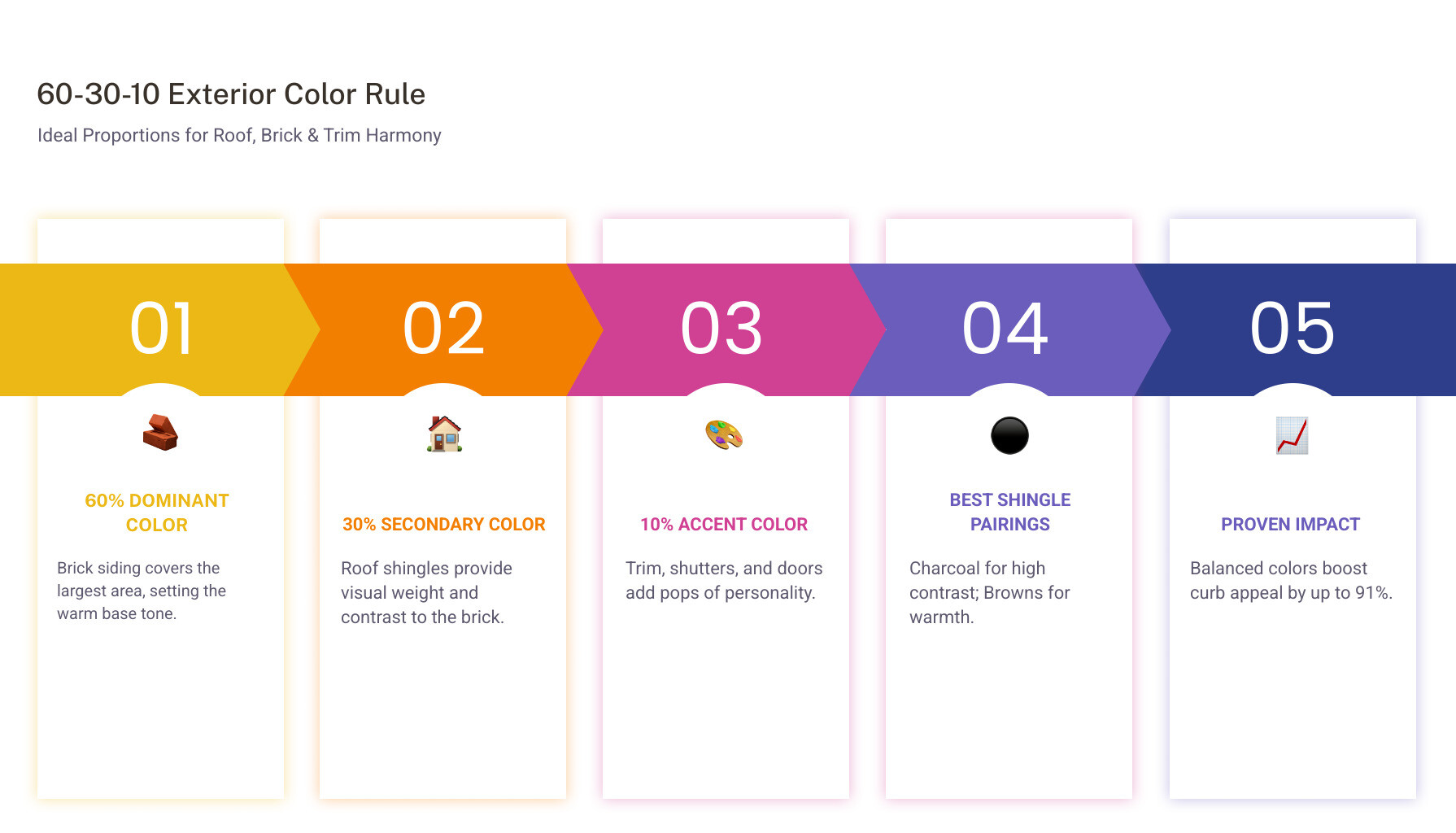
The 60-30-10 Rule
In exterior design, we use the 60-30-10 rule:
- 60% is your dominant color (the red brick).
- 30% is your secondary color (the roof).
- 10% is your accent color (trim, shutters, front door).
If you have a charcoal roof (30%), black shutters and a black front door (10%) will look incredibly cohesive. If you have white trim, a dark gray roof helps bridge the gap between the bright white and the deep red brick.
Style-Specific Recommendations
- Colonial/Federal: These homes are all about symmetry. A black or very dark gray roof with white trim and black shutters is the gold standard.
- Modern Minimalist: If you have a modern brick home with large windows and clean lines, a flat-profile charcoal or even a dark metal roof looks fantastic.
- Tudor: These homes often have darker wood “half-timbering.” A deep brown or weathered wood shingle complements the wood accents perfectly.
- Ranch: Since ranch homes have a low profile, the roof is very visible. A lighter “Weathered Wood” or slate gray can make the house feel larger and more sprawling.
If you’re struggling to visualize these styles, check out Visualizing shingle colors on Pinterest to see real-world examples of how different architectural styles handle red brick.
Frequently Asked Questions about Red Brick Roof Colors
Should the roof be darker or lighter than the red brick siding?
In 90% of cases, the roof should be darker than the brick. A darker roof “grounds” the house and makes the colors feel balanced. A roof that is significantly lighter than the brick can make the house look “top-heavy” or like it’s missing its “hat.” The only exception is if you have very dark, burgundy brick, in which case a medium-gray roof can provide a nice contrast.
What shingle colors should I avoid with red brick homes?
- Blue: Blue and red are primary colors that often fight each other. Unless you want your house to look like a flag, avoid blue-toned shingles.
- Bright Green: While a very dark Hunter Green can work on historic homes, a bright or “forest” green often clashes with the earthy tones of brick.
- Light Gray/White: These can look “washed out” against the vibrancy of red brick.
- Trendy Colors: Avoid anything too “experimental.” A roof lasts 30 years; you don’t want a color that was only cool for three of them.
How can I test and visualize different shingle colors before committing?
Don’t rely on the tiny 2-inch squares in a brochure.
- Ask for Full Samples: We always encourage our customers to ask for 2 or 3 full-sized shingles.
- The Light Test: Place the shingles against your brick and look at them at 8:00 AM, 12:00 PM, and 6:00 PM. The Utah sun changes the color of shingles drastically throughout the day.
- Digital Tools: Many manufacturers have visualizers where you can upload a photo of your actual house and “drop” different roof colors onto it.
- Drive Around: Take a drive through neighborhoods like Bountiful, Sandy, or Cottonwood Heights. Look for houses with similar brick to yours and see what roof colors you like (or hate!).
Conclusion
Choosing the color of shingles for red brick house is a big step in protecting and beautifying your home. It’s about more than just picking a color you like; it’s about finding a shade that respects your home’s architecture, handles the Utah climate, and boosts your property value.
At Heaton Bros. Roofing, we’ve been helping families across the Wasatch Front—from Logan down to Nephi—make these decisions for four generations. We aren’t just contractors; we’re your neighbors. We know which shingles stand up to the wind in Farmington and which ones handle the heat in St. George.
With over 65 years of experience, we pride ourselves on providing reliable, affordable, and high-quality roofing. If you’re ready to see how a new roof can transform your red brick home, we’re here to help.
Ready to find your perfect match? Schedule your red brick home roof consultation with us today, and let’s make your home the best-looking one on the block!